
Bubo bubo, commonly known as the Eurasian Eagle-Owl, is one of the largest and most powerful owls in the world.
Recognized by its striking orange eyes, prominent ear tufts, and deep resonant hoots, this nocturnal predator inhabits forests, rocky cliffs, and open landscapes across Europe and Asia.
As a top avian carnivore, Hunts mammals, birds, and reptiles with remarkable precision. Its impressive size, adaptability, and role in ecosystem regulation make it an important species for ecological studies and conservation.
For Practical Study 🧪
Classification of Bubo bubo (Eurasian eagle-owl)
| Rank | Classification | Characteristic |
|---|---|---|
| Kingdom | Animalia | Multicellular, heterotrophic animals |
| Phylum | Chordata | Dorsal tubular nerve cord, notochord and gill-slits present. |
| Group | Craniata | Definite head, Cranium with brain present. |
| Sub-phylum | Vertebrata | Vertebral column present. |
| Division | Gnathostomata | Jaws and paired appendages present |
| Super Class | Tetrapoda | Paired limbs, lungs, cornified skin and bony skeleton. |
| Class | Aves | Biped and feathered vertebrates. |
| Sub-Class | Neornithes | True birds. Metacarpals fused. |
| Super-Order | Neognathae | Modern birds. no teeth. sternum keeled. |
| Order | Strigiformes | Head large and rounded |
| Family | Strigidae | Typical owls, including eagle-owls and many other owl species |
| Genus | Bubo | Large eagle-owls and related owls |
| Species | Bubo bubo | Eurasian Eagle-Owl |
Geographical Distribution
World-wide distribution, specially found in India, Pakistan and Myanmar.
Habit and Habitat
Nocturnal bird, living in woody places and avoids heavy forests. It feeds on small mammals, rodents, birds, lizards and other animals. It hides in retreat in day.
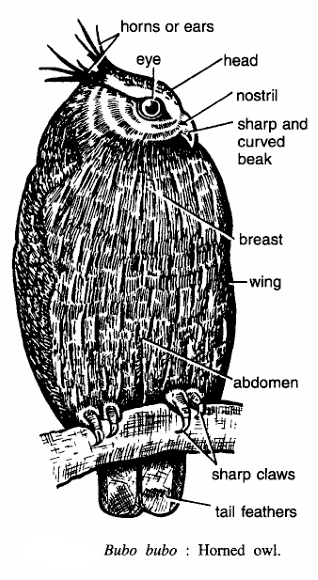
Comments
- Commonly called the Eurasian eagle owl.
- It is a fierce looking large owl with large rounded head, huge orange gold eyes and long horns or ears and nostril.
- Plumage soft textured.
- Body divided into head, back, neck, breast and abdomen.
- Bird is heavily built with dark brown back mottled and spotted with buff.
- The dark brown underside is streaked.
- Beak is short, sharp and curved and adapted for tearing and piercing.
- Eyes are large, yellow and forwardly directed, each in a disk of radial feathers.
- Wings folded over the body.
- Ear opening large, often with flap-like cover, sometimes asymmetrical.
- Legs are fully feathered. Feet adapted for grasping; claws sharp.
- Nesting season November to April.
Special Features
- Great economic value to mankind by destroying the harmful animals like rats and mice and these birds need careful protection.
- Soon after sunset, they produce deep soothing prolonged voice bubo. Mythologically owl is considered unauspicious. Academically Barn owl is very important as Camillo Golgi described Golgi body from nerve net of this owl..
Identification
Since this bird has large forwardly directed eyes and above features, hence it is Bubo.
Quick Identification of Bubo bubo
| Feature | Description |
|---|---|
| Common name | Eurasian Eagle-Owl |
| Scientific name | Bubo bubo |
| Class | Aves |
| Order | Strigiformes |
| Family | Strigidae |
| Body | Very large, robust owl |
| Head | Large head with prominent ear tufts |
| Eyes | Large, forward-facing orange to reddish-orange eyes |
| Bill | Short, strong and strongly hooked |
| Feet | Powerful feet with sharp, curved talons |
| Plumage | Brownish with dark streaking and mottling |
| Key character | Very large size, prominent ear tufts, large orange eyes and powerful talons |
Physical Characteristics of Bubo bubo
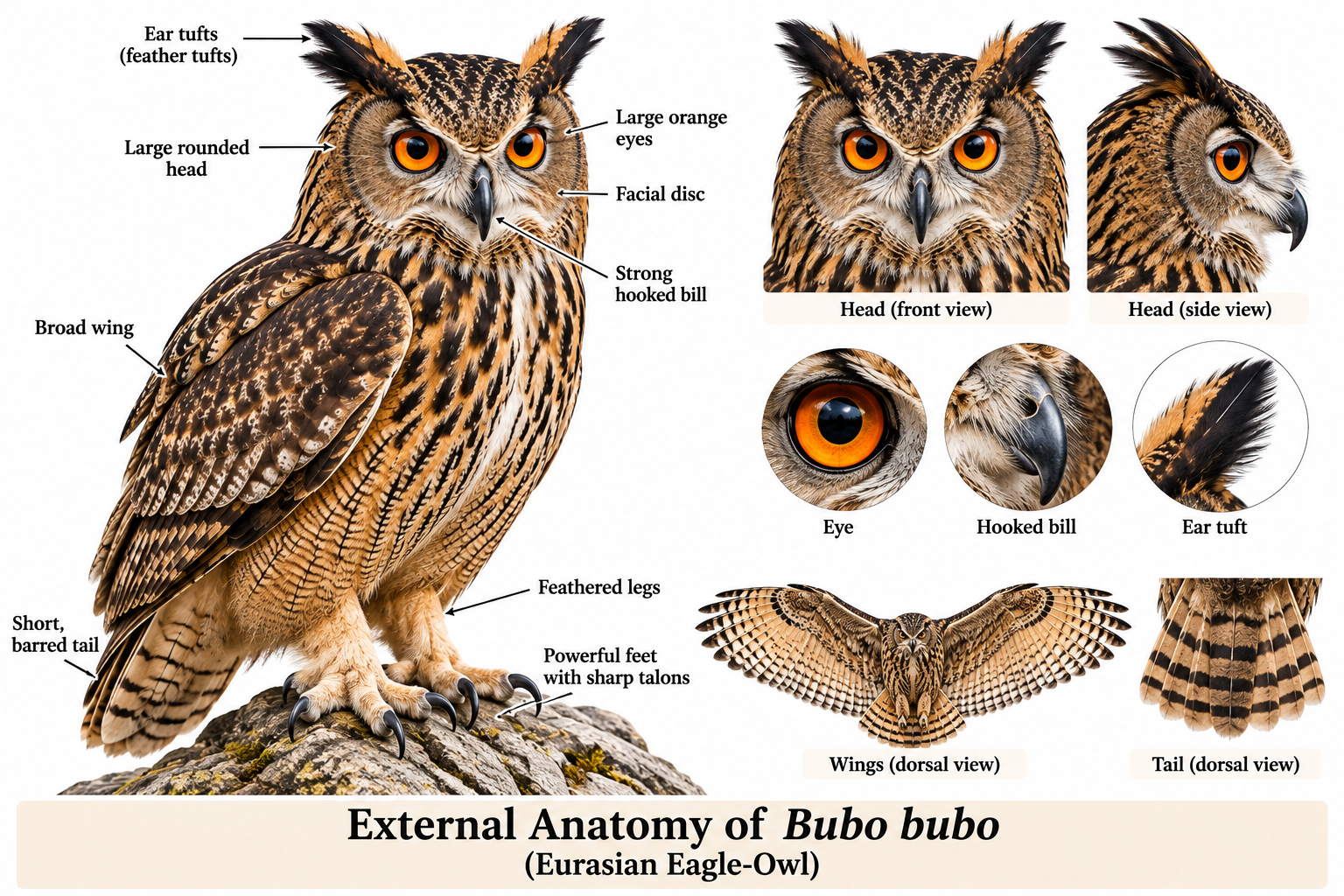
Bubo bubo, commonly known as the Eurasian Eagle-Owl, is one of the largest owl species. It has a powerful body, broad wings, a large head, prominent ear tufts and strong feet adapted for capturing prey.
Main Physical Features
- Body: Large, robust body with a broad chest and relatively short tail.
- Head: Very large and rounded, with prominent feathered ear tufts.
- Eyes: Large, forward-facing eyes, typically orange to reddish-orange, adapted for low-light vision.
- Facial disc: A well-developed facial disc surrounds the eyes and helps collect and direct sound toward the ears.
- Bill: Short, powerful and strongly hooked, adapted for tearing prey.
- Plumage: Generally brownish or buff with extensive dark streaking and mottling, providing camouflage.
- Wings: Large and broad, with specialized feathers that allow relatively quiet flight.
- Tail: Moderately long and barred.
- Legs: Strong and feathered, providing protection and helping with prey capture.
- Feet: Powerful, with sharp, curved talons used to grasp and kill prey.
- Ear openings: Located on the sides of the head and are asymmetrically positioned, an adaptation associated with sound localization.
Sexual Dimorphism in Bubo bubo
Sexual dimorphism in the Eurasian Eagle-Owl is less conspicuous than in many bird species, but females are generally larger and heavier than males. Both sexes have similar overall plumage, ear tufts and facial features.
| Feature | Male | Female |
|---|---|---|
| Body size | Generally smaller | Generally larger |
| Body weight | Usually lower | Usually higher |
| Plumage | Similar brown, streaked pattern | Similar brown, streaked pattern |
| Ear tufts | Present | Present |
| Eyes | Orange to reddish-orange | Orange to reddish-orange |
Feeding and Hunting Adaptations of Bubo bubo
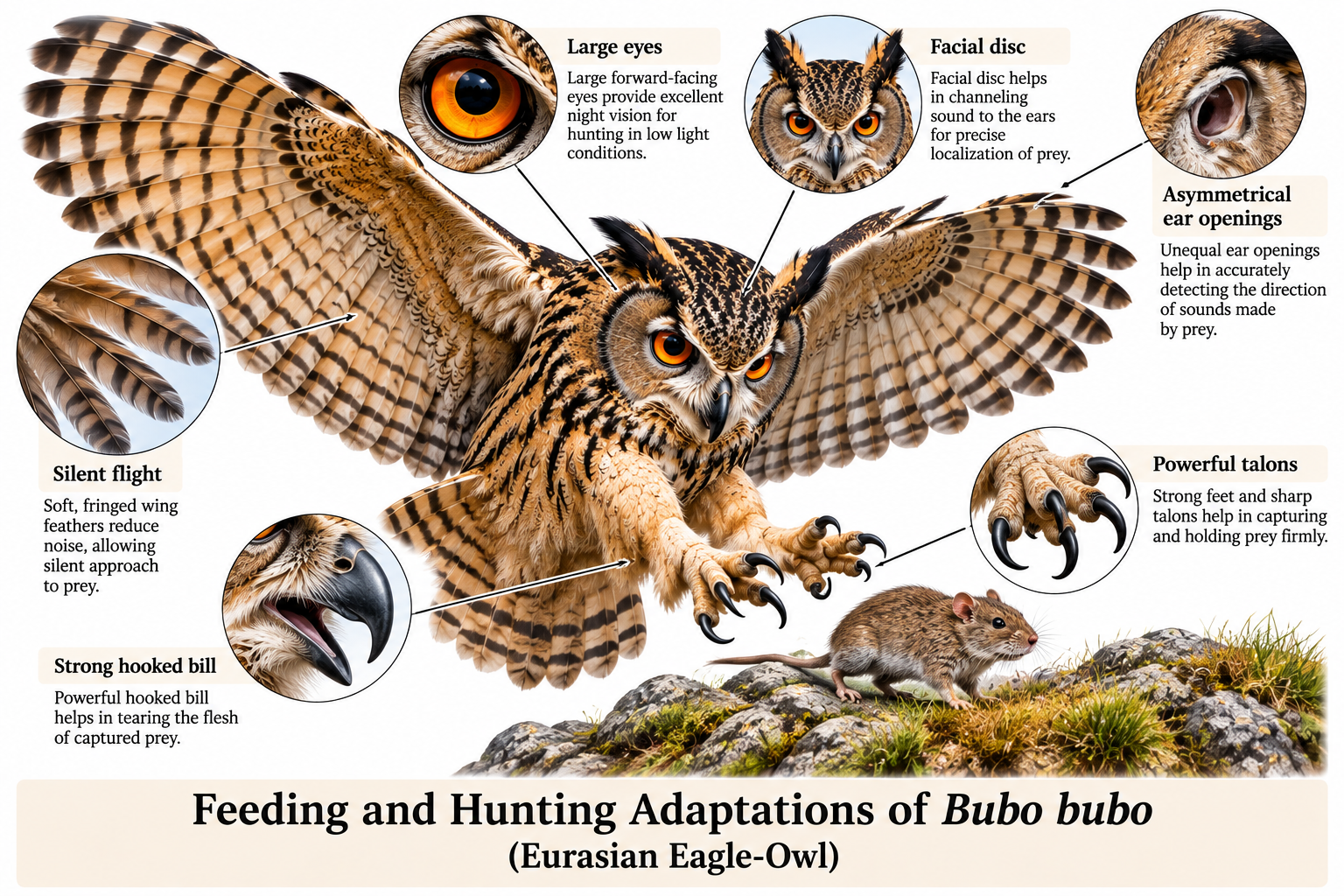
Bubo bubo is a carnivorous nocturnal predator that hunts a wide variety of prey. Its large body, powerful feet, excellent hearing and specialized flight adaptations make it an effective hunter in low-light conditions.
Diet
Its prey may include:
- Small mammals such as rodents
- Rabbits and hares
- Birds
- Reptiles and amphibians
- Large insects
- Other small to medium-sized animals
Hunting Behaviour
The Eurasian Eagle-Owl can hunt from a perch, watching and listening for potential prey before making a rapid attack. It may also fly low over suitable hunting areas. Its combination of acute hearing, low-light vision and relatively quiet flight allows it to detect and approach prey effectively.
After capturing prey, the owl uses its powerful feet and talons to restrain it. Food is swallowed in pieces or, when prey is small enough, whole. Indigestible material such as fur, feathers and bones is later compressed into pellets, which are regurgitated.
Nocturnal Adaptations of Bubo bubo
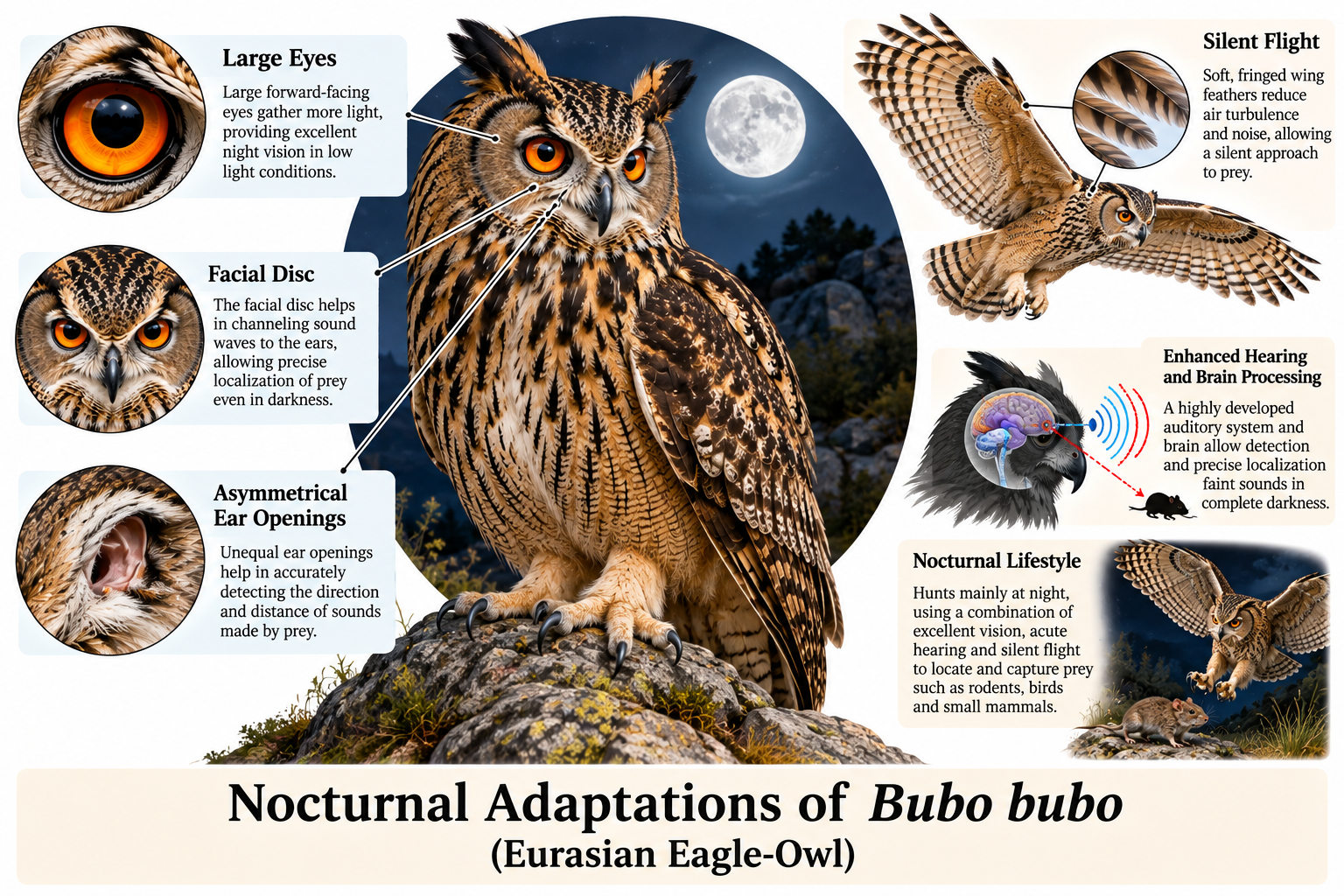
Bubo bubo is mainly active from dusk through the night, and several features help it locate and capture prey under low-light conditions.
- Large eyes: Large eyes collect available light and provide good vision in dim conditions.
- Forward-facing eyes: Their position provides substantial binocular vision and helps estimate the distance to prey.
- Facial disc: The facial feathers help collect and direct sound toward the ear openings.
- Asymmetrical ear openings: Differences in the position of the ears help the owl determine the direction and height of sounds.
- Highly sensitive hearing: Allows the owl to detect prey through sound, even when visibility is limited.
- Silent flight: Specialized wing feathers reduce turbulence and noise, helping the owl approach prey quietly.
- Camouflaged plumage: Brown and mottled plumage helps conceal the owl while it rests during daylight.
Behaviour of Bubo bubo
Bubo bubo is mainly crepuscular and nocturnal, although it may occasionally be active during daylight. It is generally territorial and spends much of the day resting in sheltered locations.
Key Behaviour
- Nocturnal activity: Most hunting and feeding occurs around dusk, at night and around dawn.
- Territorial behaviour: Adults maintain territories and may defend them using vocalizations and display behaviour.
- Vocal communication: Deep hoots and other calls are used in territorial and reproductive communication.
- Roosting: During daylight, the owl commonly rests on sheltered rocky ledges, cliffs, trees or other protected locations.
- Flight: It has powerful, controlled flight and can fly relatively quietly while hunting.
- Prey handling: Strong feet and talons are used to capture and restrain prey.
- Pellet production: Indigestible materials such as fur, feathers and bones are regurgitated as compact pellets.
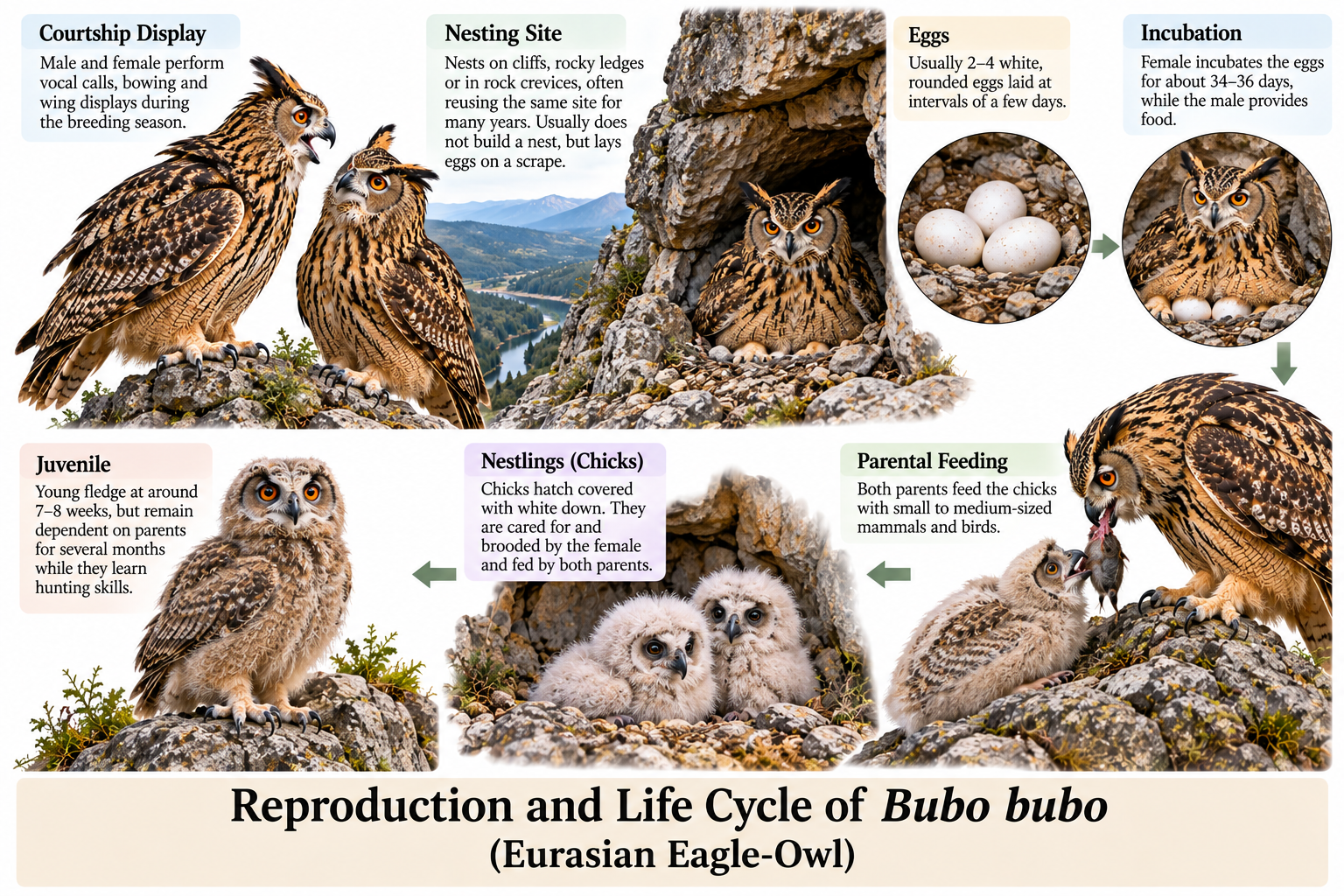
Reproduction in Bubo bubo
The Eurasian Eagle-Owl generally forms breeding pairs and uses established nesting territories. Breeding behaviour includes courtship calls, pair bonding, territorial defence and preparation of a suitable nesting site.
Reproductive Features
- Courtship: The male and female communicate through calls and other courtship behaviour.
- Nest site: The species commonly nests on rocky ledges, cliffs, caves or other sheltered locations; it generally does not construct an elaborate nest.
- Eggs: The female lays a small clutch of eggs.
- Incubation: The female performs most of the incubation.
- Parental care: The male provides food while the female remains closely associated with the nest during the early stages.
- Chicks: Young remain dependent on the parents for food and protection until they become capable of independent activity.
- Breeding strategy: The species invests substantial parental care in a relatively small number of offspring.
Conservation Status of Bubo bubo
The Eurasian Eagle-Owl is currently classified as Least Concern (LC) globally. However, local populations can still face threats depending on habitat conditions and human activities.
Major Conservation Concerns
- Loss or disturbance of suitable nesting sites
- Habitat alteration and fragmentation
- Reduction in available prey
- Collision with vehicles, power infrastructure or other structures
- Human disturbance around breeding territories
- Illegal persecution or trapping in some regions
Conservation Measures
Protection of suitable nesting cliffs, woodland and hunting habitats, along with maintaining healthy prey populations, can support local populations of Bubo bubo.
Frequently Asked Questions
What is the scientific name of the Eurasian Eagle-Owl?
The scientific name is Bubo bubo.
What is the classification of Bubo bubo?
It belongs to Kingdom Animalia, Phylum Chordata, Class Aves, Order Strigiformes and Family Strigidae.
What is the main identifying feature of Bubo bubo?
Its very large body, prominent ear tufts, large orange eyes, strongly hooked bill and powerful talons are characteristic features.
Is Bubo bubo nocturnal?
Yes. It is mainly active from dusk through the night, although occasional daytime activity can occur.
What does Bubo bubo eat?
It is carnivorous and feeds on mammals, birds, reptiles, amphibians and other suitable prey.
Why does Bubo bubo have a facial disc?
The facial disc helps collect and direct sound toward the ears, supporting efficient sound detection.
What are the ear tufts of Bubo bubo?
They are feather tufts on the head, not external ears. They are visually distinctive but are not responsible for hearing.
How does Bubo bubo hunt at night?
It uses its large eyes, sensitive hearing, facial disc, powerful talons and relatively silent flight to detect and capture prey.
What is the conservation status of Bubo bubo?
It is currently classified as Least Concern (LC) globally.
Recommended Study Resource
Practical Zoology Vertebrate 12/Ed
by Ss Lal (Author)
Rastogi Publications MODERN TEXT BOOK OF ZOOLOGY: VERTEBRATES (Z-3)
by Prof. R. L. Kotpal (Author)
As an Amazon Associate I earn from qualifying purchases.
References
- https://animaldiversity.org/accounts/Bubo_bubo/
- https://www.iucnredlist.org/
- https://ebird.org/species/eueowl1
- https://avibase.bsc-eoc.org/
Discover more from Zoologyverse
Subscribe to get the latest posts sent to your email.