
Columba livia, commonly known as the Rock Pigeon or Rock Dove, is one of the most widespread bird species in the world. Originally native to cliffs and rocky habitats of Europe, North Africa, and Western Asia, it has successfully adapted to urban environments across the globe. Known for its remarkable homing ability, varied plumage, and long association with humans, Columba livia thrives in cities, farmlands, and coastal regions. Its role in navigation studies, domestication history, and urban ecology makes it one of the most studied avian species.
For Practical Study 🧪
The following notes are arranged in a practical examination format for easy study and identification.
Classification of Columba livia (Pigeon)
| Rank | Classification | Characteristic |
|---|---|---|
| Kingdom | Animalia | Multicellular, heterotrophic animals |
| Phylum | Chordata | Dorsal tubular nerve cord, notochord and gill-slits present. |
| Group | Craniata | Definite head, Cranium with brain present. |
| Sub-phylum | Vertebrata | Vertebral column present. |
| Division | Gnathostomata | Jaws and paired appendages present. |
| Super-Class | Tetrapoda | Paired limbs, lungs, cornified skin and bony skeleton. |
| Class | Aves | Biped and feathered vertebrates. |
| Sub-Class | Neornithes | True birds. Metacarpals fused. |
| Super-Order | Neognathae | Modern birds. no teeth. sternum keeled. |
| Order | Columbiformes | Bill short and slender |
| Family | Columbidae | Pigeons and doves with compact bodies and strong flight ability |
| Genus | Columba | Medium to large pigeons with characteristic body form |
| Species | C. livia | Rock Pigeon/Rock Dove |
Geographical Distribution
Columba is commonly found in India, forested zone of the Pacific coast and United States.
Habit and Habitat
Columba livia is the most common and familiar bird around man, nesting in buildings, old houses, warehouses, sheds and railway stations. Their flight is swift and strong. Breeding continues throughout the year.
Comments
- Commonly called as blue-rock pigeon.
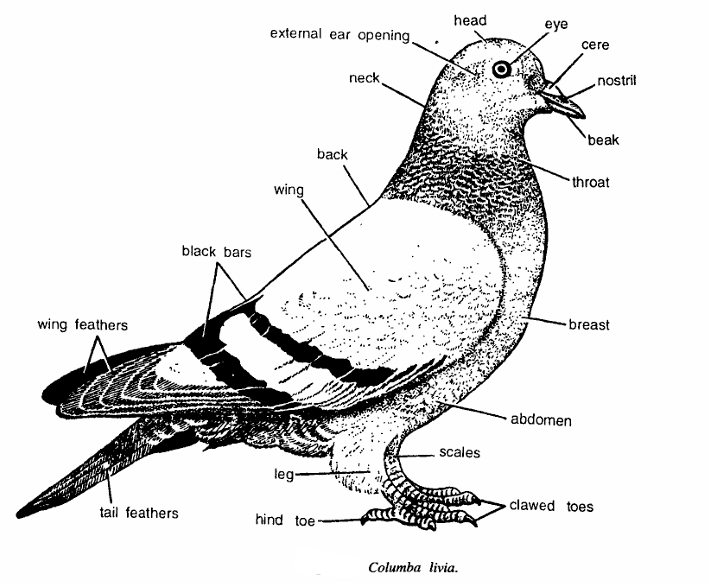
- Body is divisible into head, neck, back and breast and abdomen. Plumage is grey with glistening metallic green and purple on breast and neck.
- Head contains large eyes and slit-like nostrils.
- The mouth forms a short and slender bill or beak.
- A horny sheath called the rhamphotheca covers the upper and lower beaks.
- A patch of skin called the cere appears at the base of the upper beak.
- The beak adapts to a seed-eating diet.
- The eyes appear large and rounded, with a well-developed nictitating membrane and a rounded pupil.
- The forelimbs modify into wings that contain flight feathers known as remiges along with the skeletal elements.
- Epidermal scutes, formed by the fusion of reptilian epidermal scales, cover the feet.
- The hind limbs adapt for bipedal locomotion.
- Tarsus usually shorter than toes. Wing feathers, tail feathers present.
- Other structures seen are neck, breast, abdomen and black bars on wings. Eggs white and unmarked.
Special Features
Pigeons are the most common domesticated birds, which were in olden times used as messengers.
They are also eaten by man. Their call notes are very familiar to man as gootr-goon, gootr-goon.
Pigeons serve as an excellent example for artificial selection of Darwin’s theory of evolution as various varieties have been produced by man. Crop large, producing ‘pigeon milk’ to feed small young
Identification
Since this bird has slaty grey plumage and above features, hence it is Columba livia.
Quick Identification of Columba livia
| Feature | Description |
|---|---|
| Common name | Rock Pigeon / Rock Dove |
| Scientific name | Columba livia |
| Class | Aves |
| Order | Columbiformes |
| Family | Columbidae |
| Body | Compact, medium-sized bird |
| Plumage | Bluish-grey with iridescent neck |
| Bill | Short with a fleshy cere |
| Wings | Broad and adapted for strong flight |
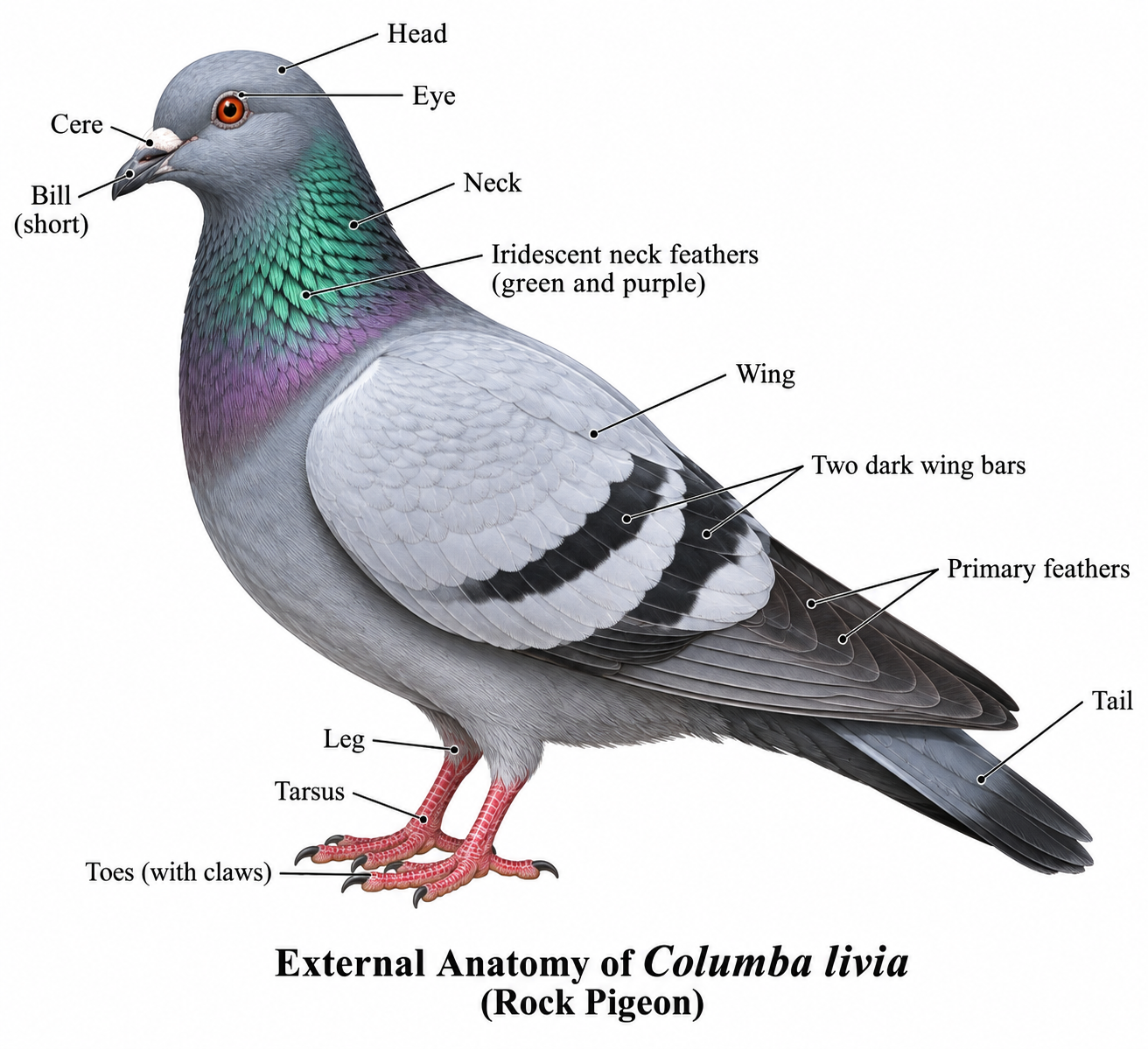
| Key identifying character | Two dark wing bars with an iridescent green-purple neck |
Physical Characteristics of Columba livia
Columba livia is a medium-sized, compact-bodied bird with a rounded head, short bill and strong wings adapted for sustained flight.
The typical wild form has bluish-grey plumage with an iridescent green and purple sheen on the neck. However, domestication has produced many different plumage patterns and colours.
Main Physical Features
- Body: Compact and moderately robust.
- Head: Small and rounded.
- Bill: Short, with a fleshy cere at its base.
- Eyes: Well-developed and adapted for visual perception.
- Neck: Shows characteristic green and purple iridescence.
- Wings: Broad and powerful, enabling strong flight.
- Wing markings: Two dark bars are typically visible across the wings.
- Tail: Relatively long with a dark terminal band.
- Legs and feet: Short legs with four toes adapted for perching and walking.
- Plumage: Usually bluish-grey in the wild form, although considerable colour variation occurs in domesticated populations.
Feeding and Adaptations of Columba livia
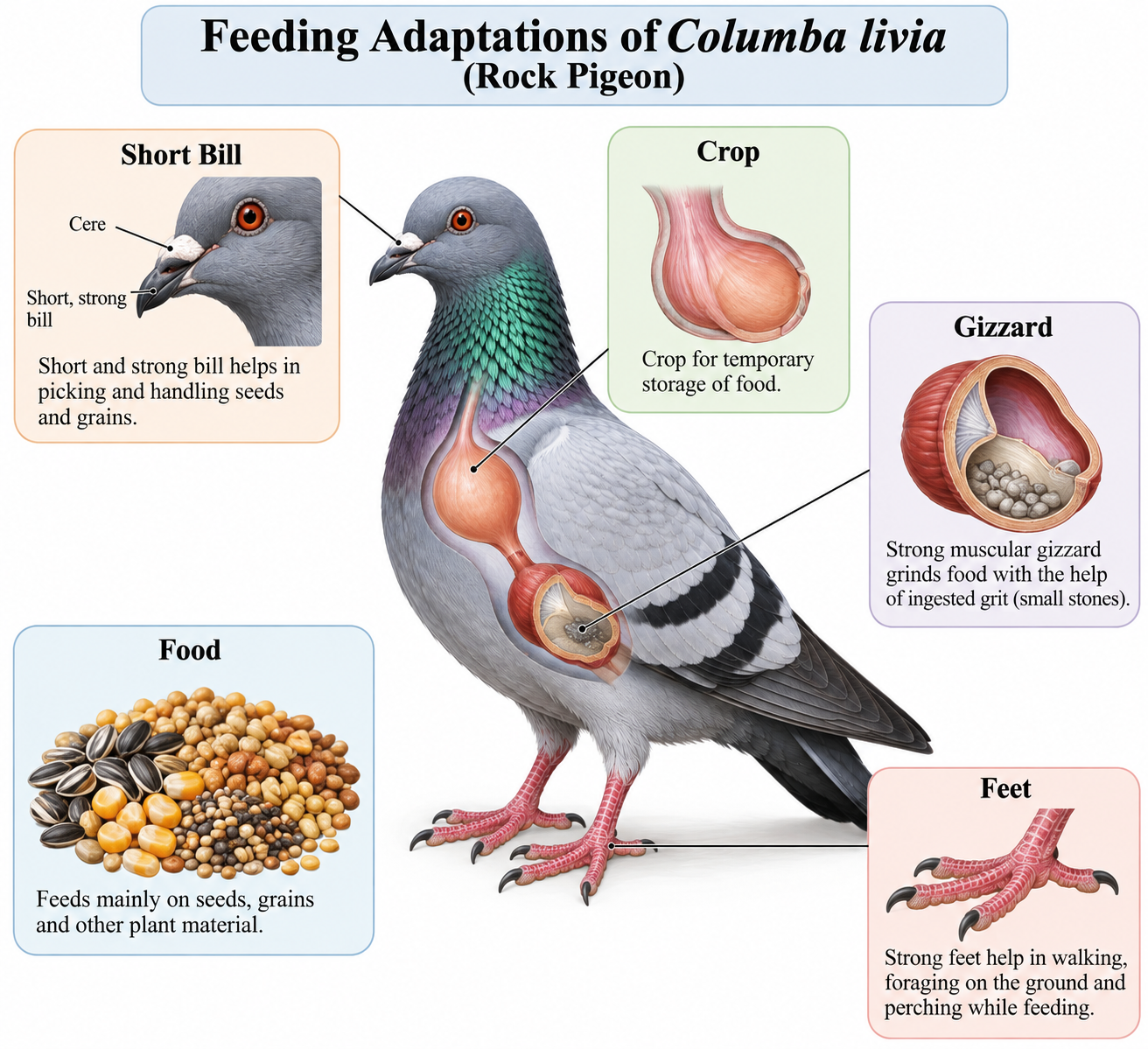
Columba livia is primarily a granivorous bird and feeds mainly on seeds, grains and other plant material. Its short bill is well suited for picking and handling food. Pigeons also have a crop, an expanded part of the digestive tract where food can be temporarily stored. In breeding adults, the crop produces a nutrient-rich secretion known as crop milk, which is used to feed the young.
| Adaptation | Function |
|---|---|
| Short, strong bill | Picks and handles seeds and grains |
| Crop | Temporarily stores food and produces crop milk |
| Broad wings | Support strong and sustained flight |
| Strong flight muscles | Enable rapid and powerful flight |
| Sharp vision | Helps locate food and detect surroundings |
| Strong feet and toes | Useful for walking and perching |
| Crop milk | Provides nutrition to developing young |
Habitat and Distribution of Columba livia
Columba livia is naturally associated with rocky habitats, especially cliffs and rocky areas near open vegetation or agricultural land.
Feral populations have adapted extremely well to human environments and commonly occupy buildings, bridges, warehouses and other structures that provide nesting sites similar to natural cliffs.
The species has been introduced widely outside its native range and is now found in many parts of the world.
Behaviour and Homing Ability of Columba livia
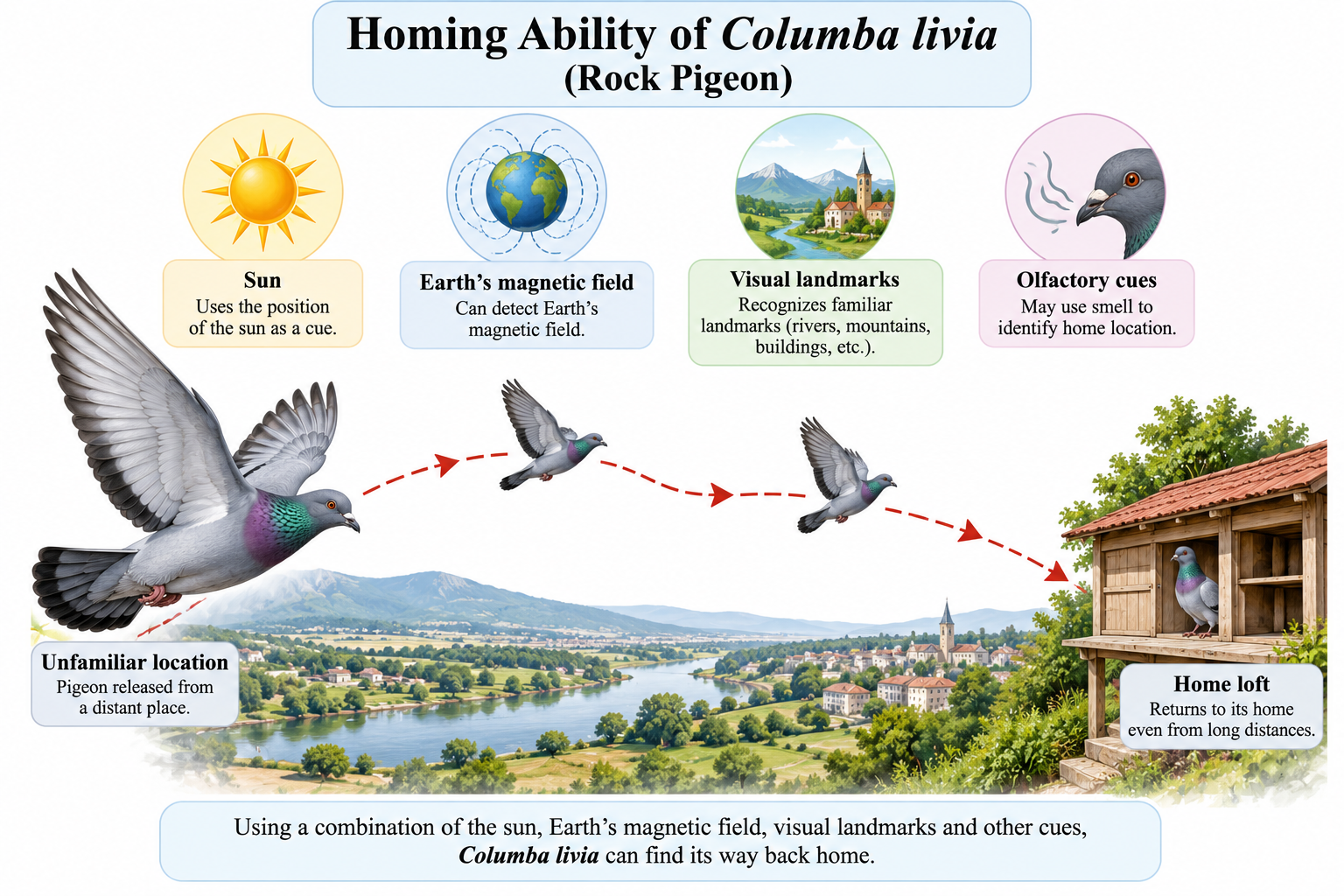
Columba livia is mainly diurnal and is commonly seen feeding, walking and flying during daylight hours. Rock pigeons are social birds and often gather in groups at feeding, drinking and roosting sites. Their strong flight ability and well-developed spatial orientation have also made pigeons important subjects in studies of navigation and homing behaviour.
Key Behavioural Features
- Social behaviour: Often occurs in groups, particularly around food and roosting sites.
- Diurnal activity: Most feeding and other activities occur during daylight.
- Strong flight: Broad wings and powerful flight muscles support rapid and sustained flight.
- Homing ability: Domestic pigeons are well known for their ability to return to a familiar home site from unfamiliar locations.
- Roosting: Buildings, ledges, cliffs and other elevated structures may serve as roosting sites.
- Adaptability: Feral populations readily exploit human-made structures as substitutes for natural rocky habitats.
Reproduction in Columba livia
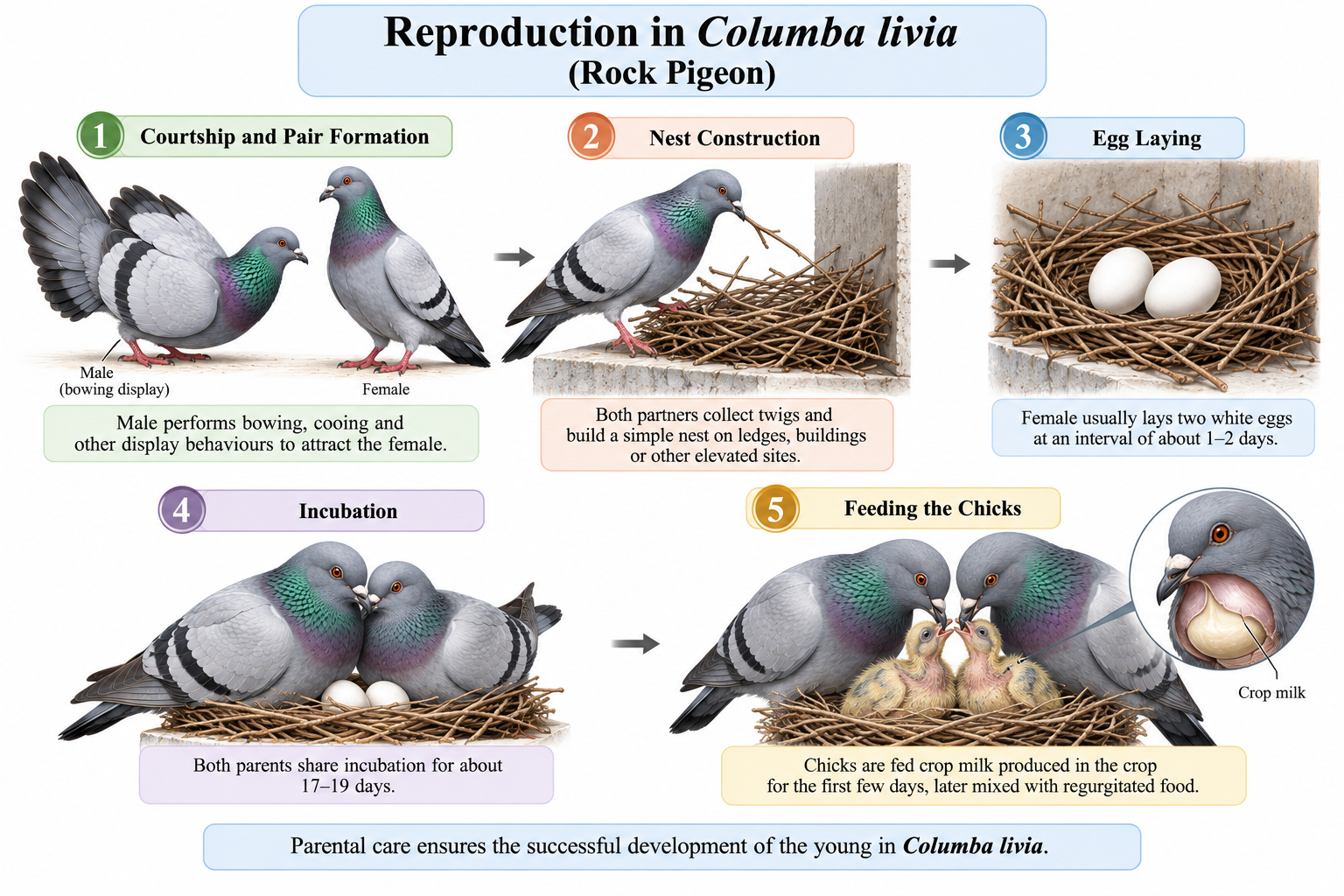
Columba livia is monogamous, and pairs may remain together for extended periods. The male helps select the nesting site and brings nesting material, while the female constructs the nest. Usually, two eggs are laid. Both parents participate in incubation and in feeding the young. The eggs generally hatch after about 19 days, and the chicks are initially fed with nutrient-rich crop milk produced by both parents.
Main Reproductive Features
- Breeding: Can occur during much of the year when suitable conditions are available.
- Nest: A simple platform made from twigs and other plant material.
- Eggs: Usually two white eggs.
- Incubation: Both parents participate.
- Incubation period: About 19 days.
- Young: Hatch helpless and depend on the parents.
- Crop milk: Provides important nutrition to the chicks during early development.
Conservation Status of Columba livia
Columba livia has a very wide distribution and is commonly associated with both natural rocky habitats and human settlements. The species is not generally considered at high global extinction risk. The IUCN Red List uses Least Concern (LC) for species that do not meet the criteria for the threatened categories.
Frequently Asked Questions
What is the scientific name of the pigeon?
The scientific name of the Rock Pigeon is Columba livia.
What does Columba livia eat?
It mainly feeds on seeds, grains and other plant material.
What is special about the crop of a pigeon?
The crop stores food temporarily and, during breeding, produces crop milk, which is used to feed the young.
How many eggs does a pigeon usually lay?
Usually two eggs. Both parents share incubation, and the eggs generally hatch after about 19 days.
Why is Columba livia important in zoology?
It has been widely studied for its homing ability, behaviour, domestication, navigation and variation in plumage.
Recommended Study Resource
A Manual of Practical Zoology – Chordates
by P S Verma (Author)
INTEGRATED PRINCIPLES OF ZOOLOGY (COLLEGE IE OVERRUNS)
by Hickman Al (Author)
As an Amazon Associate I earn from qualifying purchases.
References
- https://animaldiversity.org/accounts/Columba_livia/
- https://www.ncbi.nlm.nih.gov/Taxonomy/Browser/wwwtax.cgi?id=8932
- https://animaldiversity.org/accounts/Columbidae/
- https://animaldiversity.org/accounts/Aves/
Discover more from Zoologyverse
Subscribe to get the latest posts sent to your email.
Pingback: DISSECTION OF PIGEON | Zoologyverse
Pingback: BIRD SLIDES (Pigeon) | Zoologyverse