
The platypus (Ornithorhynchus anatinus), also known as the platypus, is a semi-aquatic egg-laying mammal endemic to eastern Australia, including Tasmania.
The platypus is the only extant species of the family Ornithorhynchidae and genus Ornithorhynchus, but many related species appear in the fossil record.
Along with four species of echidna, it is one of five extant species of monotremes, mammals that lay eggs instead of giving birth to live offspring.
Like other monotremes, the platypus has a sense of electrolocation, which it uses to detect prey underwater when its eyes, ears, and nostrils are closed.
Male platypuses have spines on each hind leg that secrete highly painful venom, making them one of the few species of venomous mammals.
| Feature | Description |
|---|---|
| Common Name | Platypus (Duck-billed Platypus) |
| Scientific Name | Ornithorhynchus anatinus |
| Class | Mammalia |
| Order | Monotremata |
| Family | Ornithorhynchidae |
| Habitat | Freshwater rivers, streams & lakes |
| Distribution | Eastern Australia & Tasmania |
| Reproduction | Oviparous (Egg-laying) |
| Special Feature | Electroreceptive bill; venomous spur in males |
Classification of Ornithorhynchus (Platypus)
- Phylum :- Chordata (Dorsal tubular nerve cord, notochord and gill-slits present.)
- Group :- Craniata (Definite head, Cranium with brain present.)
- Sub phylum :- Vertebrata (Vertebral column present.)
- Division :- Gnathostomata (Jaws and paired appendages present.)
- Super Class :- Tetrapoda (Paired limbs, lungs, cornified skin and bony skeleton.)
- Class :- Mammalia (Body covered with hairs. Females have mammary glands.)
- Sub Class :- Prototheria (Egg-laying mammals.)
- Order :- Monotremata
- Genus :- Ornithorhynchus

Geographical distribution
Found in South Eastern Australia and Tasmania. Triassic to Recent.
Habit and habitat
It is a native of rivers, pools and creeks.
It burrows to 12 to 15 metres along the river banks.
It feeds on fresh-water invertebrates, carried in cheek pouches.
General Characteristics of Ornithorhynchus (Platypus)
- Commonly called as duck-billed-platypus.
- It measures about 50 cm in length having fine short fur, dark brown colour and combines the characters of a duck with a mammal.
- Body is divided into head, thick trunk and tail. Body and tail contain soft hairs.
- Head distinct. Upper jaw produced to form a flattened beak which is covered with a smooth, hairless skin that forms a free fold at the base of the beak. Head contains nostril mouth and external ear opening.
- Adult has no teeth. Jaws covered with horny plates. Pinnae absent.
- Forelimbs and hind limbs have 5 digits, web and clawed toes.
- Hind limb has horny spur. Tail is flattened and adapted for swimming.
- Coracoid and precoracoid present. T -shaped interclavicle.
- Eyes small having nictitating membrane. Mammary glands without nipples.
- Cloaca present. Ureters open in dorsal wall of urinogenital passage. Testes abdominal, penis conducts only sperms. Oviducts distinct, uterus or vagina absent.
- Female makes nest of roots and leaves during spring in burrows, lays 1-3 eggs. About 0.5 cm long young one is hatched. It nurses by lapping up milk secreted by scattered mammary glands on the abdomen of female.
Special Features
Ornithorhynchus is an egg-laying mammal and exhibits reptilian, mammalian and intermediate characters.
Reptilian features are urinogenital system, precoracoids, absence of pinna and corpus collosum.
Mammalian features include hair, diaphragm, 4-chambered heart, 3-ear ossicles, etc.
Intermediate features include mammary glands without nipples, acromion spines in the scapulae and body temperature between 25 – 28°C is imperfect thermoregulator.
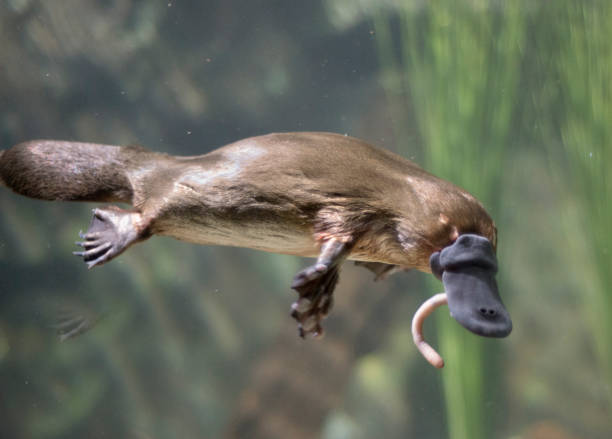
Identification
Since this mammal has flat bill and above features, hence it is Omithorhynchus

Conservation Status
The platypus is currently classified as Near Threatened by the IUCN due to habitat degradation, climate change, pollution, and river modification. Conservation efforts focus on protecting freshwater habitats and maintaining healthy river ecosystems.
Interesting Facts
- Platypus (Ornithorhynchus anatinus) is one of the five living monotremes and is an egg-laying mammal.
- It belongs to Class Mammalia and Order Monotremata. It inhabits freshwater rivers, streams, and lakes in eastern Australia and Tasmania.
- The platypus has a duck-like bill, webbed feet, dense waterproof fur, and a beaver-like tail.
- Male platypuses possess a venomous spur on the hind leg, while the bill contains electroreceptors used to detect prey.
- The platypus is an important example of mammalian evolution because it combines primitive and advanced mammalian characteristics.
Frequently Asked Questions (FAQs)
What is Ornithorhynchus (Platypus)?
Ornithorhynchus anatinus, commonly known as the platypus, is a semi-aquatic, egg-laying mammal belonging to Order Monotremata. It is native to eastern Australia and Tasmania.
Where is the platypus found?
The platypus is found in freshwater rivers, streams, lakes, and creeks of eastern Australia and Tasmania, where it lives in burrows along riverbanks.
Why is the platypus called a monotreme?
The platypus is called a monotreme because it is one of the few mammals that lays eggs instead of giving birth to live young.
Does the platypus lay eggs?
Yes. The platypus is an oviparous mammal. The female lays 1–3 eggs, incubates them in a nesting burrow, and feeds the hatchlings with milk.
What are the main characteristics of the platypus?
The platypus has a duck-like bill, webbed feet, dense waterproof fur, a beaver-like tail, and a venomous spur in males. It is also an excellent swimmer and a skilled underwater hunter.
Is the platypus venomous?
Yes. Male platypuses possess a venomous spur on each hind leg, which is mainly used during the breeding season for defense and competition. Females do not have functional venomous spurs.
What does the platypus eat?
The platypus is a carnivorous mammal that feeds on aquatic insects, insect larvae, worms, freshwater shrimp, crayfish, and other small aquatic invertebrates.
Why is the platypus important in zoology?
The platypus is considered an evolutionarily significant mammal because it combines primitive reptile-like features, such as egg laying, with advanced mammalian characteristics like fur and milk production. It provides valuable insights into the evolution of mammals.
Discover more from Zoologyverse
Subscribe to get the latest posts sent to your email.
This is the kind of writing that invites you to slow down and savor every line.