
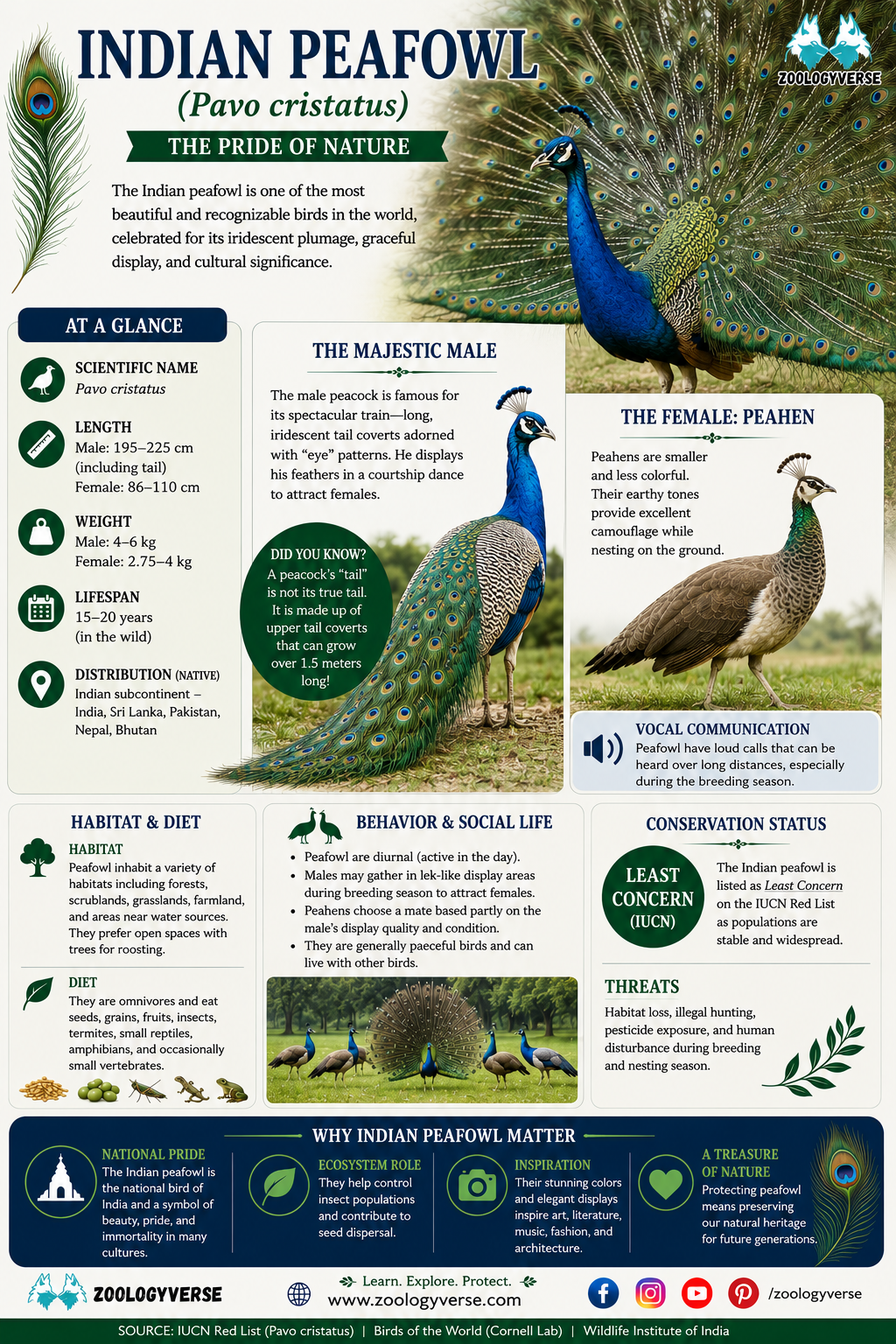
Pavo cristatus, commonly known as the Indian Peafowl or Blue Peafowl, is one of the most recognizable and culturally significant birds of the Indian subcontinent. Famous for the male’s vibrant blue plumage and spectacular fan-shaped train, this species displays elaborate courtship dances during the breeding season. Widely distributed across forests, farmlands, and village edges, Pavo cristatus is an adaptable bird that thrives in a variety of habitats. It holds national status as the National Bird of India and plays an important ecological role by controlling insects and small reptiles.
For Practical Study
Classification of Pavo cristatus
| Rank | Classification | Characteristic |
|---|---|---|
| Kingdom | Animalia | Multicellular, heterotrophic animals |
| Phylum | Chordata | Dorsal tubular nerve cord, notochord and gill-slits present. |
| Group | Craniata | Definite head, Cranium with brain present. |
| Sub-phylum | Vertebrata | Vertebral column present. |
| Division | Gnathostomata | Jaws and paired appendages present |
| Super Class | Tetrapoda | Paired limbs, lungs, cornified skin and bony skeleton. |
| Class | Aves | Biped and feathered vertebrates. |
| Sub-Class | Neornithes | True birds. Metacarpals fused. |
| Super-Order | Neognathae | Modern birds. no teeth. sternum keeled. |
| Order | Galliformes | Bill short, feathers with after shaft. |
| Family | Phasianidae | Pheasants, partridges, grouse and related galliform birds |
| Genus | Pavo | Peafowl with elaborate plumage and long display feathers |
| Species | Pavo cristatus | Indian Peafowl |
Geographical Distribution
Pavo cristatus is found in various localities across India.
Habit and Habitat
It inhabits dense scrub, jungle and forest, well provided with rivers and streams. They are shy birds. Feed on grains and vegetable shoots and often do severe harm to newly sown seeds. They also eat small reptiles and insects. It makes nests on ground.
Comments
- Commonly called as pea-fowl or peacock.
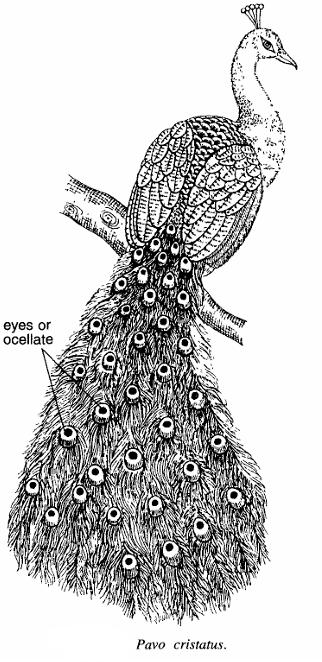
- It displays a well-marked sexual dimorphism. Body divided into head, neck, back: breast and abdomen.
- Head contains beak and eyes.
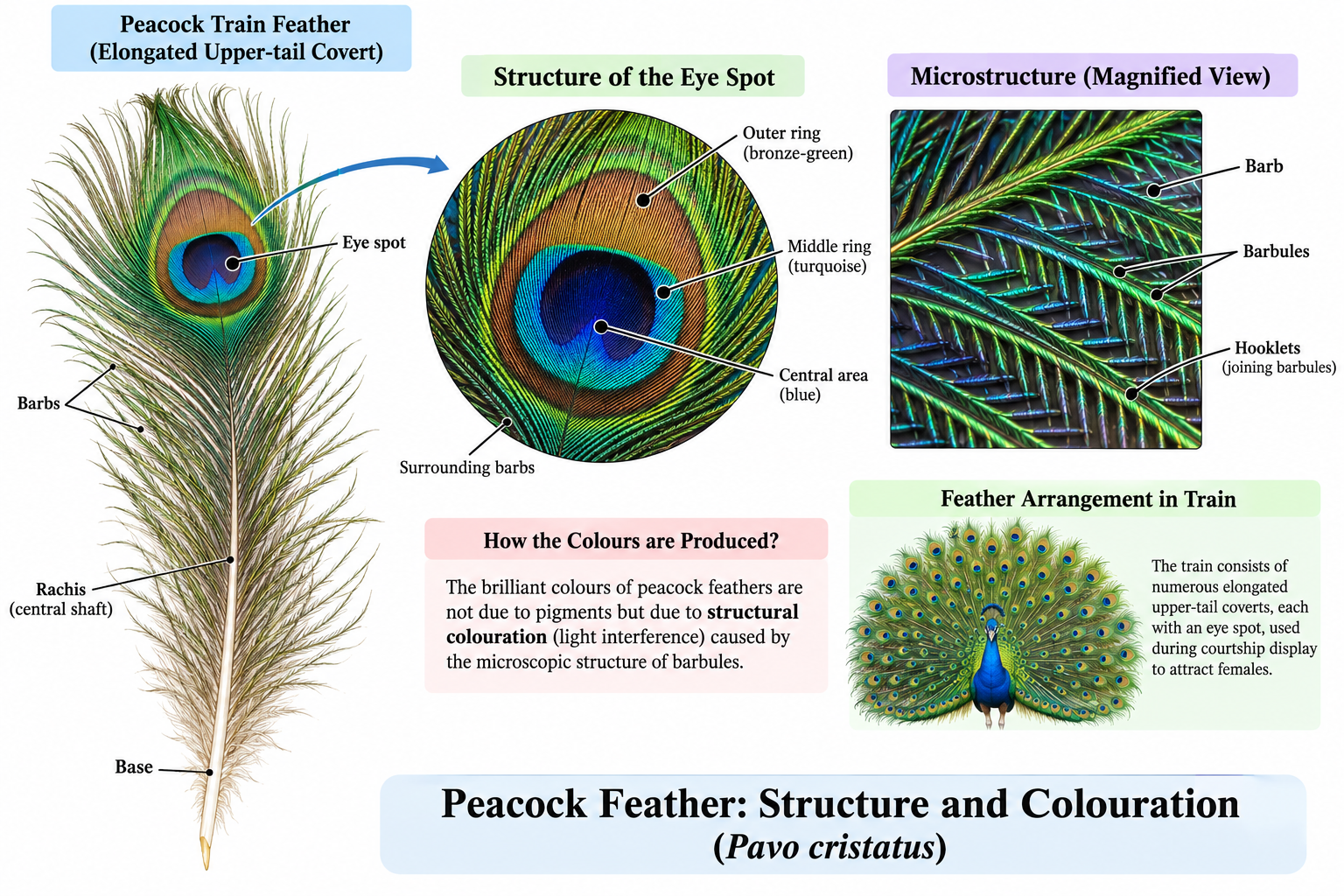
- Male bird is beautifully pigmented with fans-shaped crest; brilliant metallic blue head, neck and breast; with long trailing bronze green upper tail coverts ending in shining blue green purple bronze ‘eyes’ or ocellate.
- Train measures about 1.5 meters in length.
- Female is duller having lower neck metallic green instead of blue as in male, and lacks the ornamented tail.
- Feet adapted for scratching and running.
- Hind legs contain spur.
Special Features
The dance of the peacock with its gorgeous tail coverts spread like a fan is very famous. It dances especially on a cloudy and rainy day. It also produces ugly shrieking sound may-awe in morning, evening, moonlight and on cloudy days. The national bird of India.
Identification
Since this bird has characteristic feathers with eyes and above features, hence it is Pavo cristatus
Quick Identification of Pavo cristatus
| Feature | Description |
|---|---|
| Common name | Indian Peafowl / Blue Peafowl |
| Scientific name | Pavo cristatus |
| Class | Aves |
| Order | Galliformes |
| Family | Phasianidae |
| Body | Large terrestrial bird |
| Male Plumage | Iridescent blue neck and breast with elaborate train |
| Female plumage | Mainly brownish with a greenish neck |
| Crest | Fan-shaped crest present in both sexes |
| Bill | Short, strong and slightly curved |
| Feet | Strong legs; male has a prominent spur |
| Key identifying feature | Male’s long ornamental upper-tail coverts with prominent eyespots |
Practical identification statement: :- The specimen is identified as Pavo cristatus (Indian Peafowl) by its large body, distinctive crest, iridescent blue male plumage and, in adult males, the elongated ornamental upper-tail coverts forming the characteristic train.
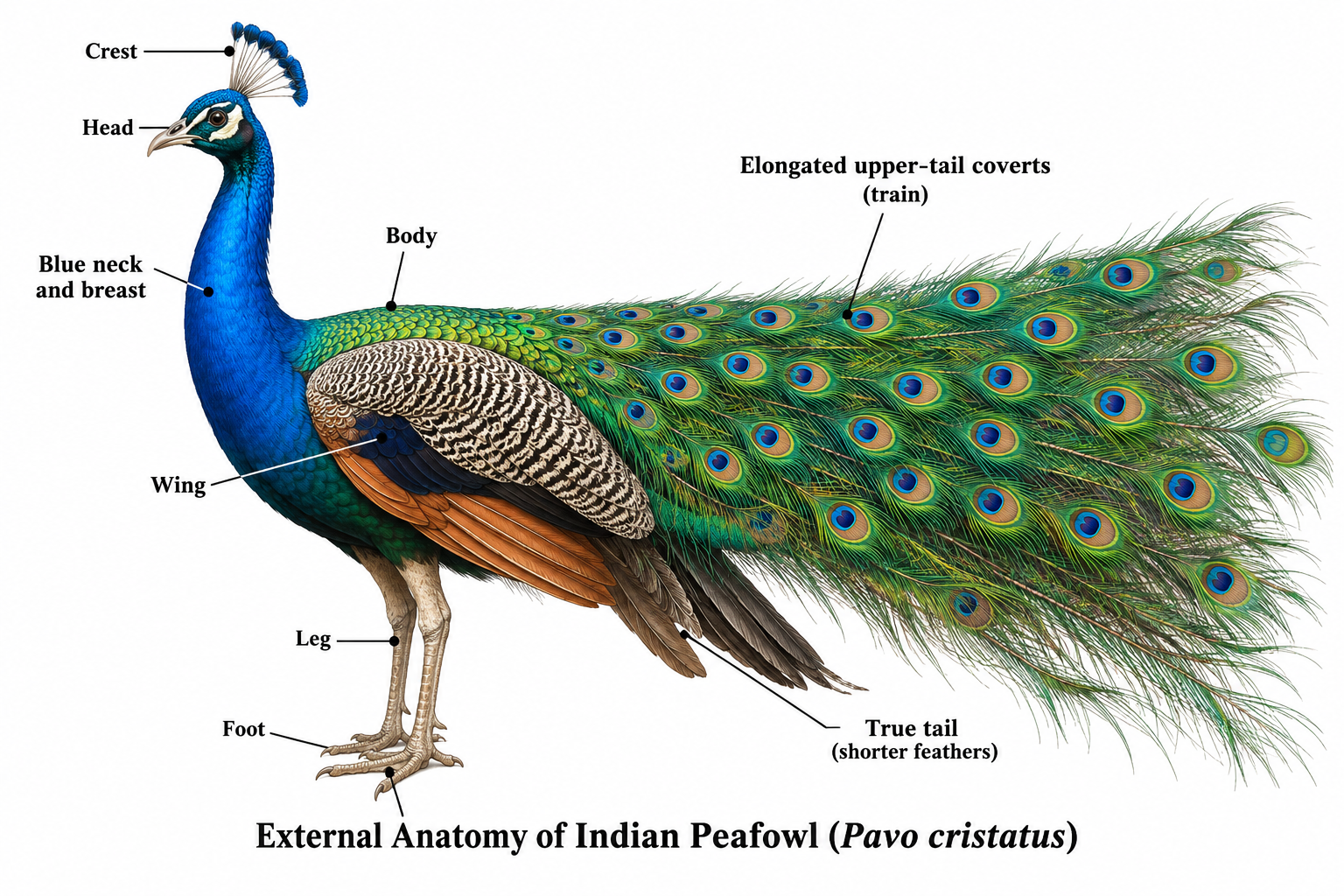
The important correction here is “train” rather than “long tail.” The spectacular display feathers are elongated upper-tail coverts, while the actual tail is much shorter and supports the train.
Physical Characteristics of Pavo cristatus
Pavo cristatus is a large terrestrial galliform bird with a strongly developed body, relatively short wings and long, strong legs adapted for walking and running. Adults show pronounced sexual dimorphism.
Male
- The head and neck are iridescent blue, with a distinctive fan-shaped crest.
- The back and body show green, bronze and other iridescent tones.
- The spectacular train consists of elongated upper-tail coverts, not the true tail feathers.
- The train bears numerous ocelli (eye-spots) and can be spread into a large fan during display.
- The legs are strong and adapted for terrestrial movement.
- Adult males possess leg spurs, which are particularly important during interactions with other males.
Female
- Females are generally less brightly coloured, with predominantly brown, grey and cream plumage.
- They have the characteristic crest but lack the elaborate male train.
- Their shorter, less conspicuous plumage provides better camouflage in vegetation.
Important practical point
Do not call the male’s display feathers its “long tail.” The spectacular train is formed mainly by elongated upper-tail coverts, while the actual tail feathers are shorter and lie beneath the train.
Sexual Dimorphism in Pavo cristatus
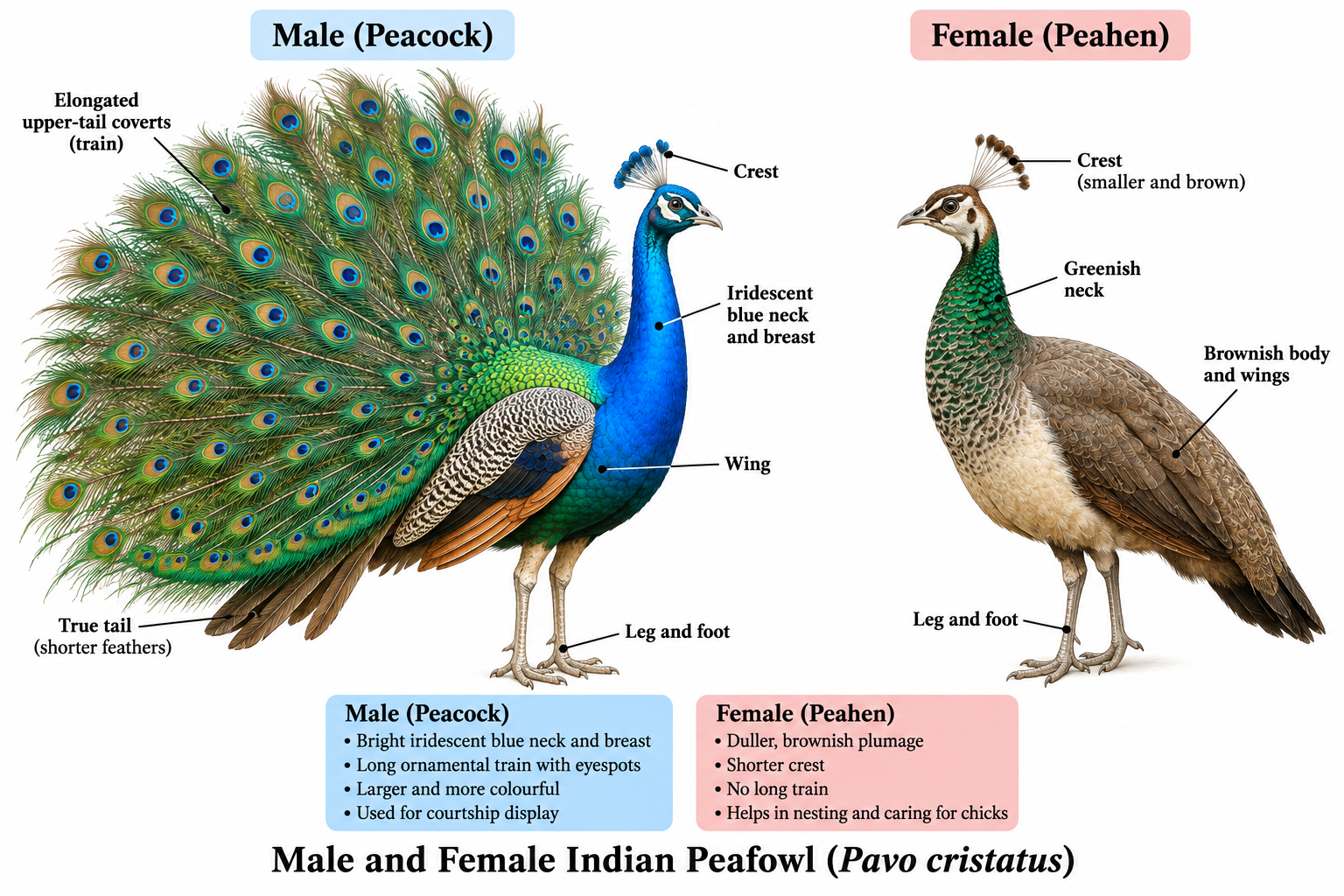
Pavo cristatus shows marked sexual dimorphism, with adult males and females differing strongly in size, plumage and ornamental structures.
| Feature | Male | Female |
|---|---|---|
| Plumage | Bright, iridescent blue and green | Mainly brownish/grey with greenish neck |
| Neck | Brilliant blue | Greenish |
| Crest | Present | Present |
| Train | Very long and elaborate, with numerous ocelli | Absent |
| Leg spurs | Usually prominent | Usually absent or much less developed |
| Body appearance | More conspicuous | More cryptic |
Practical significance :- The long ornamental train with eyespots is the most distinctive feature of the adult male. Females lack this elaborate train and have more subdued coloration, which provides better camouflage during nesting.
Habitat
Pavo cristatus is native to the Indian subcontinent and is especially associated with India and neighbouring parts of South Asia. It occurs in a variety of habitats rather than being restricted to dense forests.
- Open forests and woodland
- Dry deciduous forests
- Scrublands and grassland edges
- Agricultural landscapes
- Riverine and semi-open habitats
- Areas around villages and human settlements
Peafowl generally prefer habitats that provide cover, feeding grounds, water and suitable trees for roosting. They can also persist in human-modified landscapes when suitable food, vegetation and shelter are available.
Distribution
The species has a broad native distribution across the Indian subcontinent, with India forming the core of its range. Populations also occur naturally in parts of Pakistan, Nepal and Sri Lanka.
Practical point: Pavo cristatus is primarily a terrestrial bird, although it commonly climbs trees and uses elevated branches for roosting.
Feeding and Dietary Adaptations of Pavo cristatus
Pavo cristatus is an omnivorous, ground-feeding bird. Its diet is varied and changes according to the available food in its habitat.
Diet
It commonly feeds on:
- Seeds and grains
- Fruits and berries
- Young shoots and plant material
- Insects and other small invertebrates
- Small reptiles and other small animal prey.
Behaviour and Courtship of Pavo cristatus
Pavo cristatus is mainly diurnal and terrestrial, spending much of its time walking and feeding on the ground. It commonly roosts in trees at night and may gather in small groups, particularly around feeding or roosting areas.
Courtship and Display
During the breeding season, the adult male performs an elaborate courtship display:
- The male raises and spreads his ornamental train into a large fan.
- The numerous ocelli (eye-spots) become highly visible.
- He positions and moves the train toward the female during courtship.
- The display is accompanied by characteristic calls and body movements.
- Females assess males during these courtship interactions.
Other Behaviour
- Peafowl are generally active during daylight.
- They spend considerable time walking and foraging on the ground.
- They can fly despite their large size, particularly to reach trees for roosting or escape danger.
- They commonly roost on elevated branches at night.
Reproduction in Pavo cristatus
Breeding involves courtship displays by the male followed by mating and nesting by the female. The female generally builds a simple nest on or near the ground, often concealed among vegetation.
Reproductive Features
- Courtship: The male displays his ornamental train and performs characteristic courtship movements.
- Nest: Usually a shallow nest placed on the ground and hidden in vegetation.
- Eggs: The female lays a clutch of eggs, with clutch size varying among individuals and conditions.
- Incubation: The female performs most or all of the incubation.
- Parental care: The female cares for the chicks after hatching.
- Chicks: Young are precocial and can walk and follow the mother soon after hatching.
Conservation Status of Pavo cristatus
The Indian Peafowl (Pavo cristatus) is currently classified as Least Concern (LC) on the IUCN Red List. However, local populations can still be affected by habitat loss, hunting, poisoning, disturbance and changes in agricultural landscapes.
Major Conservation Concerns
- Loss and fragmentation of suitable habitat
- Hunting and illegal capture in some areas
- Reduced availability of natural food and water
- Human–wildlife conflict in agricultural areas
- Habitat disturbance around nesting and roosting sites
Conservation approach: Protecting suitable woodland, scrub, agricultural landscapes and water sources helps maintain local peafowl populations.
Frequently Asked Questions
What is the scientific name of the Indian Peafowl?
The scientific name of the Indian Peafowl is Pavo cristatus.
What is the classification of Pavo cristatus?
Pavo cristatus belongs to Kingdom Animalia, Phylum Chordata, Class Aves, Order Galliformes and Family Phasianidae.
What is the main identifying feature of the male peafowl?
The adult male is recognized by its iridescent blue neck, crest and spectacular train of elongated upper-tail coverts bearing prominent eyespots.
Is the peacock’s train its tail?
No. The spectacular display train is formed mainly by elongated upper-tail coverts. The true tail feathers are shorter and support the train.
What does Pavo cristatus eat?
It is an omnivore that feeds on seeds, grains, fruits, plant material, insects and other small animal food.
Where does the Indian Peafowl live?
It occurs mainly across the Indian subcontinent and uses open forests, woodland, scrub, agricultural landscapes and areas near human settlements.
What is the conservation status of Pavo cristatus?
The Indian Peafowl is currently classified as Least Concern (LC) on the IUCN Red List.
What is the difference between a peacock and a peahen?
A peacock is an adult male, while a peahen is an adult female. The male has the elaborate train and much brighter plumage, whereas the female has more subdued coloration.
Related Zoology Topics
- Classification of Columba livia (Rock Pigeon)
- Classification of Phoenicopterus (Flamingo)
- Classification of Gyps bengalensis (White-rumped Vulture)
- General Characteristics of Aves
Recommended Study Resource
Practical Zoology Vertebrate 12/Ed
by Ss Lal (Author)
Rastogi Publications MODERN TEXT BOOK OF ZOOLOGY: VERTEBRATES (Z-3)
by Prof. R. L. Kotpal (Author)
As an Amazon Associate I earn from qualifying purchases.
References
- https://animaldiversity.org/accounts/Pavo_cristatus/
- https://datazone.birdlife.org/species/factsheet/indian-peafowl-pavo-cristatus
- https://www.iucnredlist.org/
- https://ebird.org/species/indpea1
- https://avibase.bsc-eoc.org/
Discover more from Zoologyverse
Subscribe to get the latest posts sent to your email.