
Petromyzon, commonly known as the sea lamprey, is a jawless vertebrate belonging to the family Petromyzontidae.
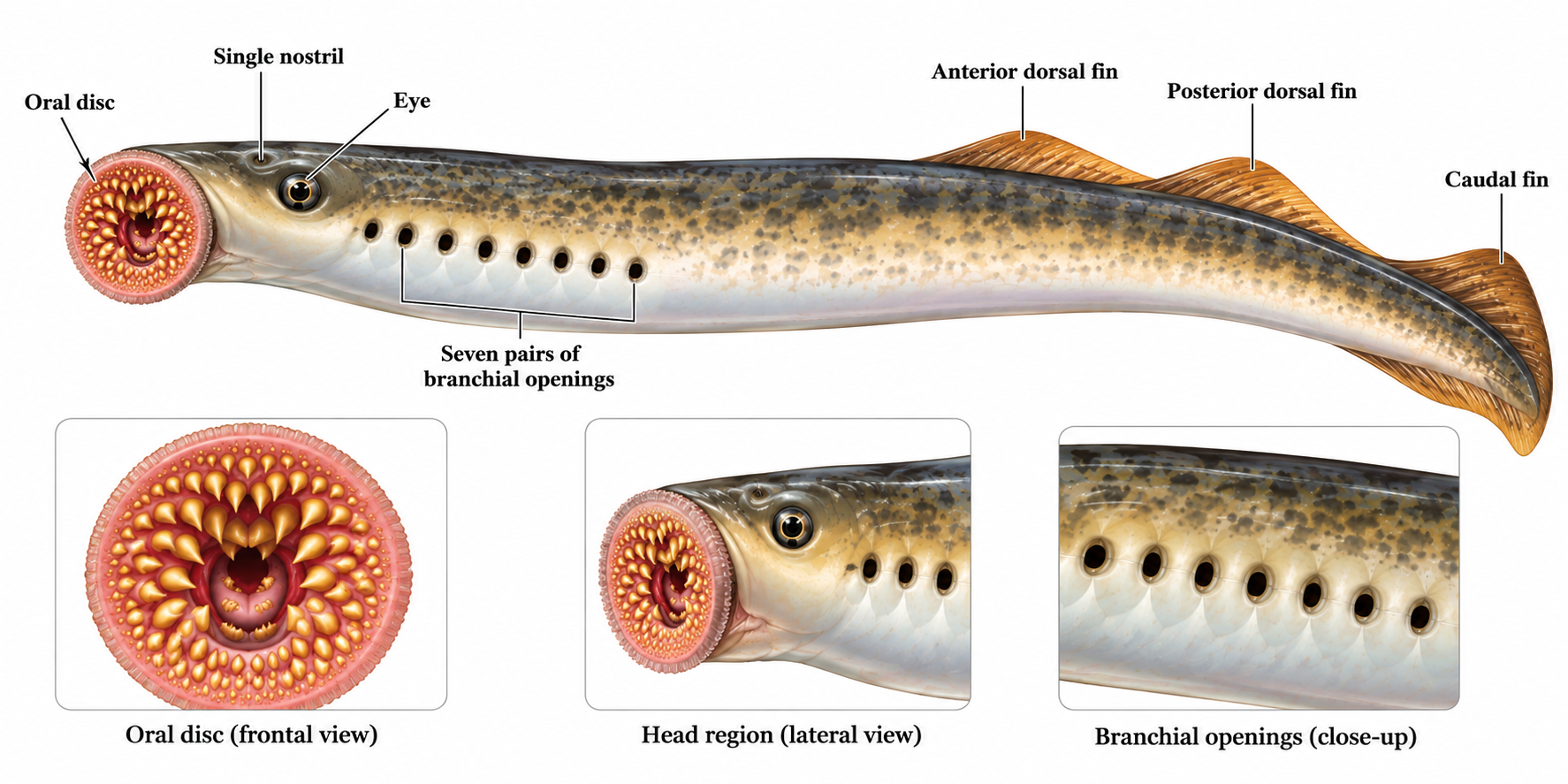
The species Petromyzon marinus has an elongated, eel-like body characterized by a circular suctorial mouth, numerous horny teeth, seven pairs of external branchial openings, and the absence of jaws and paired fins.
The adult sea lamprey is generally parasitic and attaches to fish and other aquatic hosts using its suctorial oral disc.
Its life cycle includes a distinctive ammocoete larval stage, which lives in freshwater sediments and feeds mainly by filtering suspended organic matter and microorganisms.
After metamorphosis, the young lamprey may migrate downstream to marine or brackish waters, where it develops into an adult before returning to freshwater for reproduction.
Petromyzon is important in zoology because its jawless body plan, specialized feeding apparatus, branchial system, and distinctive life cycle provide important examples for understanding Cyclostomata and the diversity of early vertebrates.
Lampreys and hagfishes are important groups of living jawless vertebrates studied in comparative zoology.
Practical Study
The following notes are arranged in a practical examination format for easy study and identification.
Classification of Petromyzon marinus
| Rank | Classification | Characteristic |
|---|---|---|
| Kingdom | Animalia | Multicellular, heterotrophic animals |
| Phylum | Chordata | Notochord and dorsal hollow nerve cord present |
| Subphylum | Vertebrata | Vertebrate lineage; a persistent notochord forms the main axial support |
| Class | Petromyzontida | Jawless vertebrates with a suctorial mouth and elongated body |
| Order | Petromyzontiformes | Lampreys with a circular oral disc and seven pairs of branchial openings |
| Family | Petromyzontidae | Lampreys characterized by an elongated body and suctorial oral disc |
| Genus | Petromyzon | Lampreys with a circular suctorial mouth and elongated body |
| Species | Petromyzon marinus | Commonly known as the sea lamprey |
Geographical Distribution
Distribution :- North Atlantic, western Atlantic, Mediterranean region, and certain inland waters of North America.
Petromyzon marinus is native to the North Atlantic region. It occurs along the eastern Atlantic coast from northern Europe southward to northern Africa and in the western Atlantic from Labrador and the Gulf of St. Lawrence southward to Florida and the Gulf of Mexico.
It also occurs in the Mediterranean Sea, particularly its western and central parts.
Landlocked populations occur in parts of North America, including in most of the Great Lakes, Finger Lakes, Oneida Lake, and Lake Champlain.
In most of the Great Lakes region, populations outside the native range became established following introduction and subsequent spread.
Habit and Habitat
Petromyzon marinus is an aquatic, migratory and predominantly parasitic lamprey.
Adult sea lampreys usually live in marine or coastal waters, where they attach to fish using their circular suctorial oral disc and feed on body fluids and tissues.
The species is anadromous, meaning adults migrate from marine or coastal waters into freshwater streams and rivers for reproduction.
Its ammocoete larva has a different habit and lives partially buried in soft sediments of freshwater streams, where it feeds mainly by filter feeding on microorganisms and organic particles.
In short:
Adult → marine/coastal waters → parasitic feeding
Larva → freshwater sediments → filter feeding
Adult → freshwater migration for spawning

Comments
- Commonly called as sea lamprey
- Body is eel-like, measuring about 90 cm, and differentiated into head, trunk and tail.
- First dorsal fin, second dorsal fin and caudal fin confluent.
- Skin is without scales, slimy, green, brown and with strong metallic lustre.
- Head contains mouth but no jaws.
- Mouth is surrounded by a large, ventral, suctorial funnel with numerous horny teeth.
- The ‘tongue’ is toothed and piston-like.
- Dorsal nasal sac and mouth are unconnected. Paired eyes are present behind nasal-aperture.
- Gill-slits are 7 pairs and branchial basket is well developed.
- Sexes are separate, Female with large anal fin, Male with urinogenital or copulatory papilla.
- The development includes ammocoete larva which is very important phylogenetically as it is regarded a connecting link between Amphioxus and cyclostomes.
Special Features
- Jawless mouth: The mouth forms a circular suctorial oral disc and lacks true jaws.
- Horny teeth: The oral disc bears numerous horny teeth that help the adult attach to and feed from host fishes.
- Seven pairs of branchial openings: Seven external gill openings are present on each side of the body.
- Single median nostril: A single median nasal opening is present on the dorsal side of the head.
- Absence of paired fins: Pectoral and pelvic fins are absent.
- Persistent notochord: The notochord persists throughout life and forms the principal axial support.
- Distinct larval stage: The ammocoete larva differs considerably from the adult in structure, habitat and feeding habit.
- Parasitic adult: The adult can attach to fish with its oral disc and feed on their body fluids and tissues.
- Anadromous life cycle: In typical populations, adults migrate into freshwater to reproduce after spending part of their life in marine or coastal waters.
- Spawning migration: Adults migrate upstream to suitable freshwater habitats for spawning, after which the adults die.
Identification
Identified as Petromyzon marinus (Sea Lamprey) by its elongated body, circular suctorial mouth with horny teeth, seven pairs of branchial openings, and absence of jaws and paired fins.
External Features of Petromyzon
Petromyzon marinus has an elongated, eel-like body that is roughly cylindrical in the anterior region and becomes laterally compressed toward the tail.
The body can be divided into head, trunk and tail.
Head :- The head bears a large circular suctorial oral disc. The disc is surrounded by the oral structures and contains numerous horny teeth, which help the adult attach to its host, A single median nostril is present dorsally, while a pair of well-developed eyes occurs laterally.
Trunk :- The trunk is elongated and lacks paired fins. Seven pairs of external branchial openings occur laterally behind the head, The skin is smooth and without scales, with numerous mucous glands that keep the body slippery.
Tail :- The posterior region forms the tail and bears median fin folds, The tail becomes laterally compressed and assists in swimming.
Key External Features
- Elongated, eel-like body
- Circular suctorial oral disc
- Numerous horny teeth
- Single median nostril
- Seven pairs of branchial openings
- Absence of paired fins
- Smooth, scaleless skin
- Median caudal fin folds
Digestive System of Petromyzon
The digestive system of Petromyzon is adapted to its parasitic feeding habit. In the adult, the mouth forms a circular suctorial disc that attaches firmly to the body of a fish.
Mouth and Buccal Cavity
The oral disc bears numerous horny teeth. The tongue is muscular and also bears horny teeth.
These structures help the lamprey rasp the skin of its host and maintain attachment.
Pharynx
The pharynx is divided functionally into separate feeding and respiratory passages.
During feeding, food passes from the mouth toward the oesophagus, while the branchial region is primarily associated with respiration.
Alimentary Canal
The alimentary canal consists mainly of:
Mouth → Buccal cavity → Pharynx → Oesophagus → Intestine → Anus
The intestine is relatively simple and contains a typhlosole, a longitudinal fold that increases the absorptive surface.
Feeding
Adult Petromyzon commonly attaches to fish with its oral disc.
Its teeth and muscular tongue help break the host’s skin, after which the lamprey feeds on blood and tissue fluids.
Secretions from the oral region help prevent clotting of the blood.
Ammocoete Larva
The feeding habit of the larva differs greatly from that of the adult.
The ammocoete larva lives partially buried in freshwater sediments and mainly filter-feeds on microorganisms and organic particles.
Key point: The digestive system shows a marked difference between the filter-feeding ammocoete larva and the parasitic adult.
Respiratory System of Petromyzon
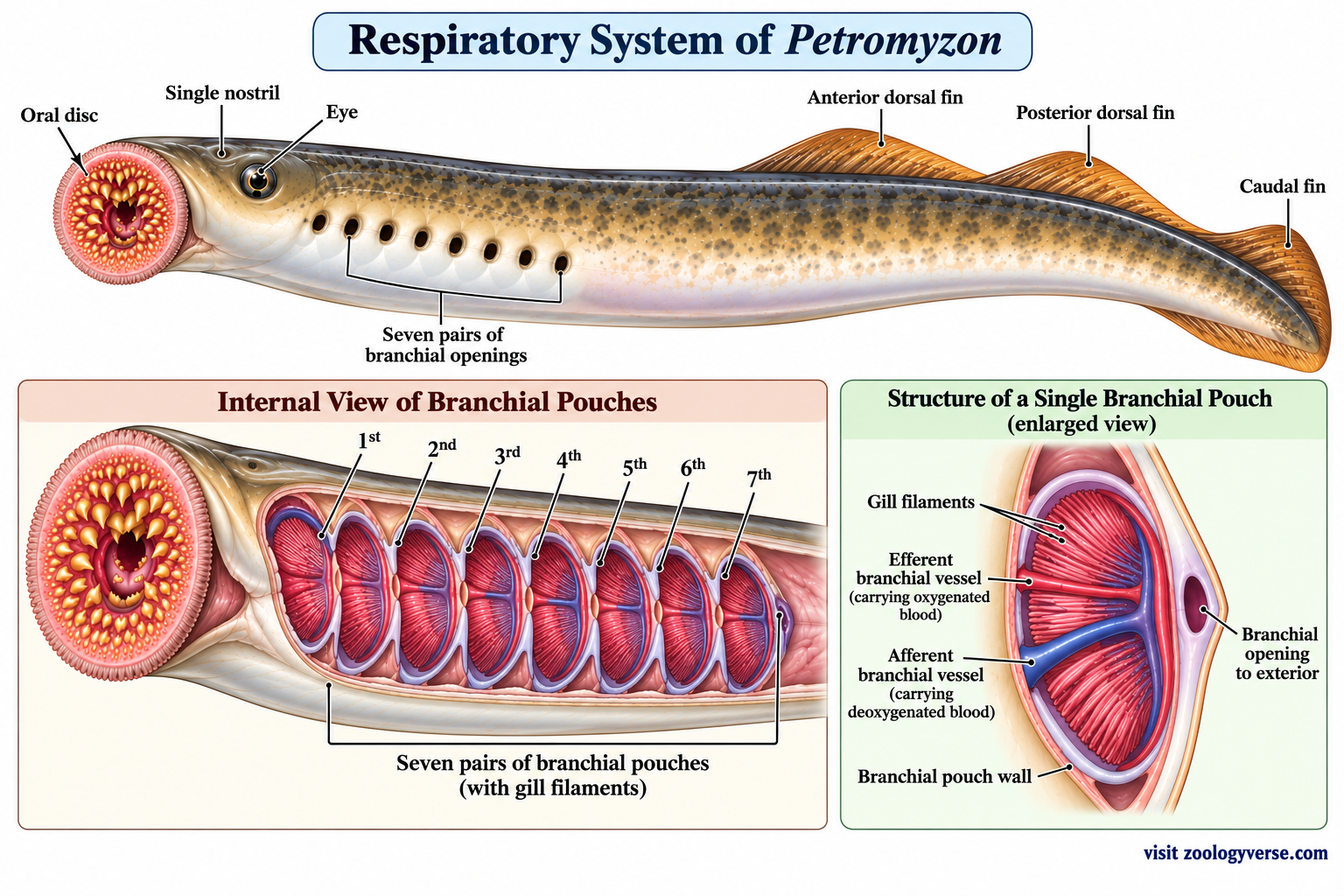
The respiratory system of Petromyzon is specialized for aquatic respiration and consists of a series of paired branchial pouches connected with external branchial openings.
Branchial Apparatus
There are seven pairs of branchial pouches situated on either side of the pharyngeal region.
Each pouch opens externally through a separate branchial aperture.
The walls of the branchial pouches contain numerous blood vessels, providing a large surface for gaseous exchange.
Respiration
Water enters the respiratory passages and passes over the vascular respiratory surfaces, where oxygen is absorbed and carbon dioxide is released.
In the adult lamprey, respiration can continue while the animal is attached to a host.
Water can enter and leave through the branchial openings without requiring continuous passage through the mouth.
Ammocoete Larva
The ammocoete larva has a different feeding and respiratory arrangement.
Water enters through the mouth and passes through the pharyngeal region, where food particles are filtered and respiratory exchange takes place.
Key Features
- Seven pairs of branchial pouches
- Seven pairs of external branchial openings
- Highly vascular respiratory surfaces
- Aquatic respiration through gill pouches
- Adult can respire while attached to a host
Circulatory System of Petromyzon
The circulatory system of Petromyzon is closed, with blood flowing through arteries, capillaries and veins.
The heart is situated ventrally in the anterior part of the body.
Heart
The heart consists of:
- Sinus venosus
- Atrium
- Ventricle
The sinus venosus receives deoxygenated blood from the body and passes it into the atrium.
The atrium transfers blood to the ventricle, which pumps it toward the branchial arteries.
Blood Circulation
Deoxygenated blood from the body enters the sinus venosus → atrium → ventricle → ventral aorta.
From the ventral aorta, blood is distributed to the branchial region through the branchial arteries.
After gaseous exchange in the gill pouches, oxygenated blood is collected by the dorsal aorta, which distributes it to different parts of the body.
Important Features
- Circulation is closed.
- Heart is two-chambered, with an atrium and ventricle.
- Sinus venosus is present.
- Blood passes through the branchial region for oxygenation.
- Single circulation occurs, with blood passing through the heart once during one complete circuit.
Excretory System of Petromyzon
The excretory system of Petromyzon consists mainly of a pair of elongated kidneys located dorsally in the body cavity.
The kidneys remove nitrogenous wastes from the blood and help maintain the body’s water and ionic balance.
Kidneys
The kidneys are elongated and extend along much of the trunk region. They contain numerous renal tubules associated with blood vessels.
The renal tubules filter waste materials from the blood and contribute to the regulation of water and salts.
Urinary Ducts
Urine produced by the kidneys passes through the urinary ducts and is discharged to the exterior through the urogenital region.
Key Features
- A pair of elongated kidneys is present.
- Kidneys contain numerous renal tubules.
- They remove nitrogenous metabolic wastes.
- They help regulate water and salt balance.
- Urine is discharged through the urogenital opening.
Nervous System of Petromyzon
The nervous system of Petromyzon consists of a brain, spinal cord, cranial nerves and peripheral nerves.
It coordinates sensory information, swimming movements, feeding and other body functions.
Brain
The brain is differentiated into the major regions:
- Forebrain (prosencephalon)
- Midbrain (mesencephalon)
- Hindbrain (rhombencephalon)
The olfactory organs are well developed, while the eyes are functional in adults.
Spinal Cord
A long dorsal tubular spinal cord extends posteriorly from the brain through the body. It gives rise to nerves that supply the trunk and associated muscles.
Sense Organs
Important sensory structures include:
- Eyes – well developed in adults.
- Olfactory organ – associated with the single median nostril.
- Lateral-line sensory system – detects mechanical disturbances and water movements.
Key Features
- Dorsal brain and spinal cord.
- Well-developed olfactory sense.
- Functional eyes in adults.
- Lateral-line sensory system.
- Nervous system coordinates swimming, feeding and sensory responses.
Reproductive System and Life Cycle of Petromyzon
Petromyzon is dioecious, with separate male and female individuals.
The gonads are single and elongated, and the reproductive organs undergo major development before the breeding migration.
Reproduction
Adult sea lampreys migrate from marine or coastal waters into freshwater streams and rivers for spawning.
During the breeding season, the gonads mature and the adults become sexually reproductive.
The female releases eggs into a nest constructed in gravel or coarse sediment, while the male releases sperm over the eggs.
Fertilization is external.
After spawning, the adults normally die.
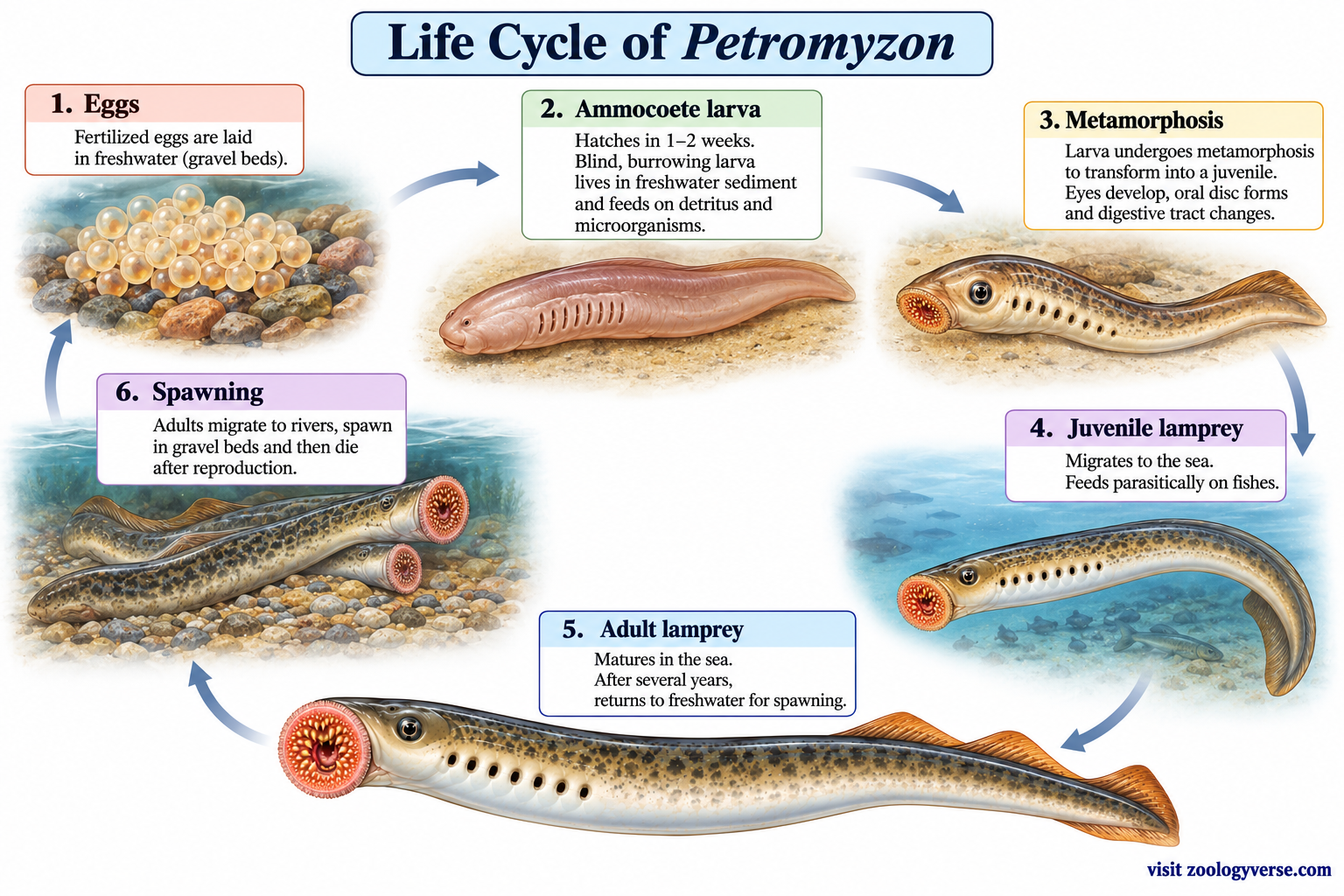
Life Cycle
The life cycle includes the following major stages:
Egg → Ammocoete larva → Metamorphosis → Juvenile → Adult
Ammocoete Larva
The newly hatched larva develops into the ammocoete, a long, eel-like larva that lives partially buried in soft freshwater sediments.
It is mainly a filter feeder, unlike the parasitic adult.
Metamorphosis
After several years of larval development, the ammocoete undergoes metamorphosis.
During this process, major changes occur in the mouth, eyes, digestive system and other structures, producing the juvenile/adult form.
Adult Stage
The adult migrates downstream toward marine or coastal waters in typical anadromous populations.
After a period of growth and feeding, it eventually returns to freshwater to reproduce.
Key Features
- Sexes are separate.
- Fertilization is external.
- Breeding occurs in freshwater.
- Ammocoete larva is a distinctive larval stage.
- Larva is mainly a filter feeder.
- Adult is adapted for parasitic feeding.
- Adults generally die after spawning.
Ecological Importance of Petromyzon
Petromyzon marinus has an important role in aquatic ecosystems, although its ecological effects vary depending on the ecosystem and population.
- Food-web role: Sea lampreys form part of aquatic food webs, with different life stages serving as prey for other animals.
- Nutrient transfer: Their migrations between marine and freshwater environments can contribute to the movement of nutrients between ecosystems.
- Host interactions: Adult lampreys influence fish populations through their parasitic feeding.
- Ecosystem effects: In regions where sea lampreys are introduced, particularly the Great Lakes, their parasitic feeding can have substantial effects on native fish populations.
The ecological status of P. marinus is region-dependent. It is native in parts of its Atlantic range but is considered an invasive species in the North American Great Lakes, where control programs have been developed to reduce its impact on native fish.
Conservation Status and Management
Conservation Status
The conservation status and ecological significance of Petromyzon marinus depend on the region. It is a native species in much of its North Atlantic range, while populations introduced into the North American Great Lakes are managed as an invasive species because of their effects on native fish.
Management of Invasive Populations
In the Great Lakes, sea lamprey populations are managed using measures such as:
- Lampricides to control larvae in streams.
- Barriers that limit access to suitable spawning areas.
- Trapping of migrating adults.
- Monitoring of populations and spawning streams.
These measures are particularly important in the Great Lakes, where sea lampreys have contributed to declines in commercially and ecologically important fish populations.
Important Note
The sea lamprey is not considered endangered overall. Its status varies by region, and management concerns are greatest where it has been introduced.
Ammocoete Larva of Petromyzon
The ammocoete is the characteristic larval stage in the life cycle of Petromyzon. It differs considerably from the adult in its feeding habit, habitat and external features.
The ammocoete stage is important in understanding the distinctive life cycle of lampreys and their adaptation to different aquatic environments.
For a full account of its structure and features, see our detailed article on the Ammocoete Larva.
Frequently Asked Questions
What is Petromyzon?
Petromyzon is a genus of jawless vertebrates commonly known as lampreys. Petromyzon marinus is the sea lamprey.
Why is Petromyzon called a jawless vertebrate?
It lacks true jaws. Its mouth forms a circular suctorial oral disc equipped with horny teeth.
How many pairs of gill openings are present in Petromyzon?
Petromyzon has seven external gill openings on each side of the body, which makes seven pairs (14 openings in total).
What is an ammocoete larva?
The ammocoete is the distinctive larval stage of a lamprey. It lives in freshwater sediments and mainly feeds by filter feeding.
Is Petromyzon parasitic?
The adult sea lamprey is generally parasitic, attaching to fish with its oral disc and feeding on their tissues and body fluids.
Does Petromyzon have paired fins?
No. Paired fins are absent in Petromyzon.
Where does the sea lamprey reproduce?
Adult sea lampreys migrate into freshwater streams and rivers for spawning.
What is the main identifying feature of Petromyzon?
The combination of an elongated body, circular suctorial mouth with horny teeth, seven pairs of branchial openings, and absence of jaws and paired fins is characteristic.
Recommended Study Resource
Fishes of the World
by Joseph S. Nelson (Author), Terry C. Grande (Author), Mark V. H. Wilson (Author)
Vertebrates: Comparative Anatomy, Function, Evolution
by Kenneth Kardong (Author)
As an Amazon Associate I earn from qualifying purchases.
References
- Nelson, J. S., Grande, T. C., & Wilson, M. V. H. Fishes of the World. Wiley.
- Kardong, K. V. Vertebrates: Comparative Anatomy, Function, Evolution. McGraw-Hill.
- Hickman, C. P. et al. Integrated Principles of Zoology. McGraw-Hill.
- FishBase. Petromyzon marinus (Sea Lamprey).
- U.S. Geological Survey. Sea Lamprey information and species profile.
Discover more from Zoologyverse
Subscribe to get the latest posts sent to your email.
Pingback: CYCLOSTOMATA SLIDES of Ammocoete Larva | Zoologyverse